
Sermorelin sits in an interesting spot. It has a real approval history, a clear mechanism, and plenty of online buzz. You’ll see how sermorelin works and what the research shows. You’ll also see where FDA stands, how monitoring works, and how to choose a provider. The guide ends with checklists you can take to your own clinician.
The Quick Answer. Sermorelin is a synthetic peptide. It copies the first 29 amino acids of growth hormone-releasing hormone (GHRH). It prompts your pituitary to release your own growth hormone in pulses. FDA approved it in the 1990s for children with growth hormone deficiency. The manufacturer later discontinued it for commercial reasons. Today clinicians prescribe it through compounding pharmacies.
Sermorelin at a Glance
This snapshot covers the essentials. Each row points to a section below.
| Item | Snapshot |
| Type | Synthetic peptide, a GHRH analog |
| Length | 29 amino acids |
| How It Works | Prompts the pituitary to release growth hormone |
| Original Approval | FDA-approved in 1997 for children with growth hormone deficiency |
| Today’s Supply | Compounding pharmacies |
| Main Monitoring Marker | IGF-1 |
| Sport | WADA prohibits it |
What Is Sermorelin?
Sermorelin is a synthetic peptide, a short chain of amino acids. It’s a lab-made copy of the first 29 amino acids of GHRH. GHRH is the signal your hypothalamus sends to the pituitary to release growth hormone. Sermorelin delivers that same signal.
Those first 29 amino acids carry the signaling activity of the full hormone. That’s why a shorter peptide can do the same job in the pituitary.
How Sermorelin Works
The process follows four steps.
- Sermorelin binds GHRH receptors on the pituitary gland.
- The pituitary releases growth hormone in pulses.
- Growth hormone signals the liver to make IGF-1.
- IGF-1 carries out many of growth hormone’s effects on tissue and metabolism.
Because the signal runs through the pituitary, your body’s natural brakes stay active. Somatostatin, a hormone that limits growth hormone release, keeps working. That’s the main difference from injecting growth hormone itself.
Sermorelin acts at the first step of the pathway. IGF-1 is the downstream hormone, which is why monitoring focuses there.
Growth Hormone, Sleep, and Your Daily Rhythm
Your body doesn’t release growth hormone at a steady level. It releases it in bursts, and the largest bursts usually happen during deep sleep. That link explains why sleep and growth hormone come up together so often.
It also means good sleep habits support the whole system, whatever else you try.
Sermorelin vs. HGH
The two work in different places. This table shows how.
| Feature | Sermorelin | Human Growth Hormone (HGH) |
| What It Does | Prompts your pituitary to release your own growth hormone | Supplies growth hormone directly |
| Feedback Loop | Natural feedback stays in place | Natural feedback is bypassed |
| Monitoring | IGF-1, glucose, and thyroid | IGF-1, glucose, and thyroid |
| Approved Uses | None currently, since the original product was discontinued | FDA-approved for specific conditions, including growth hormone deficiency |
Sermorelin works through the existing growth hormone pathway. HGH bypasses that pathway. Pharmacy and clinical sources describe them as different drugs that don’t act the same way.
Sermorelin vs. Ipamorelin and CJC-1295
Growth hormone peptides work through two receptor systems. Sermorelin and CJC-1295 are GHRH analogs that signal through the GHRH receptor. Ipamorelin is a growth hormone secretagogue that works through the ghrelin receptor.
FDA Approval History
FDA approved sermorelin under the brand name Geref in 1997 for two uses in children. Those uses were diagnosing growth hormone deficiency and treating growth failure from low growth hormone. The manufacturer voluntarily withdrew it by 2008.
In 2013, FDA determined that the product wasn’t withdrawn for reasons of safety or effectiveness. Today’s supply comes from compounding pharmacies.
Sermorelin Timeline at a Glance
This table lines up the key dates in sermorelin’s regulatory story.
| Year | Event |
| 1997 | FDA approves the original product for children |
| 2008 | The manufacturer withdraws the product |
| 2013 | FDA states the withdrawal wasn’t for safety or effectiveness |
| 2023 | The Endocrine Society reviews hormones and aging |
| March 2025 | FDA’s 503B nominations list places sermorelin in Category 1 |
| October 2026 | Supply continues through compounding pharmacies |
What the Research Shows by Goal
Most evidence comes from studies of growth hormone itself or the wider GHRH class. Sermorelin-specific trials in healthy adults are the next step for researchers.
| Goal | Evidence Type | What You Can Say |
| Body Composition | Reviews of growth hormone therapy in older adults | Small changes in fat and lean mass |
| Sleep | Mechanism and user reports | Plausible, awaiting sermorelin trials |
| Energy and Recovery | User reports | Awaiting controlled studies |
| Skin, Focus, and Mood | User reports | Awaiting clinical trials |
A 2007 review covered 31 articles on growth hormone therapy in healthy older adults. Fat mass fell about 2.1 kg, and lean mass rose about 2.1 kg. Body weight didn’t change. That review studied growth hormone itself. It doesn’t describe sermorelin directly.
The best-documented sermorelin research involves children. A 1999 review covers its use in diagnosing and treating children with idiopathic growth hormone deficiency. That’s the setting where FDA approved the original product.
How to Read Before-and-After Stories
A useful story includes more than two photos. Use this list to read any claim.
- What were the person’s age, baseline, and diagnosis?
- Which product did they use, and who dispensed it?
- Which lifestyle changes ran at the same time?
- Which outcomes did they measure, and did they check IGF-1?
Sleep, diet, training, and stress all change body composition. Those factors help explain why two people report different results.
Lifestyle Factors That Shape Results
Lasting changes in body composition often depend on lifestyle habits. Five habits come up most often.
- Adequate protein.
- A sensible calorie balance.
- Good sleep habits.
- Resistance training.
- Stress management.
These habits help explain why two people on the same plan report different experiences. A clinician or dietitian can tailor each one to you.
Three Kinds of Claims
Not every claim carries the same weight. Anecdotal reports describe personal experiences, but they can’t prove cause and effect. Phrases like “clinically studied” show a product was tested, not that it worked. Peer-reviewed trials give the strongest evidence. Match each claim you read to one of these three types.
Monitoring Sermorelin Treatment
Monitoring keeps treatment on track. IGF-1 is the main marker, because it stays steadier in the blood than growth hormone. Common practice tests at baseline and again at four to eight weeks. Your clinician sets your schedule.
- IGF-1 at baseline and during treatment.
- A metabolic panel and fasting glucose.
- A thyroid panel.
- A side-effect log with dates.
This table shows how a plan can unfold over time. Your clinician sets the real schedule.
| Stage | What Happens |
| Before Starting | Baseline IGF-1, metabolic panel, and thyroid labs |
| Early Check | A repeat IGF-1 to see how your body responds |
| Ongoing | Periodic labs and a review of your goals |
| Any Time | A call to your clinician about new symptoms |
Who Should Talk With a Clinician About Sermorelin?
The established clinical role is treating growth hormone deficiency confirmed by testing. Adults interested in wellness goals also have good reasons to start the conversation.
- Adults curious about sleep, recovery, or body composition. A clinician helps you set goals that match today’s evidence.
- People with diabetes, thyroid conditions, or a cancer history. Individual review matters most here.
- People who are pregnant or nursing. Review any new compound with a clinician first.
- Athletes subject to testing. Check current WADA and league rules first.
A legitimate evaluation includes a detailed history, a discussion of risks, and baseline labs. Valid telehealth prescribing also rests on a provider-patient relationship built on an adequate history. An endocrinologist is a reasonable place to start.
Choosing a Provider and Pharmacy
Good providers answer these questions clearly.
- Which compounding pharmacy prepares the medication?
- What level of licensed clinician oversight is involved?
- How often is follow-up scheduled?
- Which labs happen before and during treatment?
- How are side effects managed?
Verify each clinician’s license with the Texas boards. Verify the pharmacy’s license with the Texas State Board of Pharmacy. Ask for the answers in writing, and keep them with your records.
Checking Product Quality and Documentation
Good documentation answers practical questions. Look for these items on your label and paperwork.
- The product name and the exact form.
- The preparing pharmacy’s name and license.
- A lot number and a beyond-use date.
- Storage instructions for your exact product.
- Testing documents from the pharmacy or manufacturer.
A certificate of analysis speaks to identity and purity. Sterility and clinical effect need separate assurance. Ask your pharmacist to walk you through each item.
What Does Sermorelin Cost?
Cost depends on the pharmacy, the dose, and the cycle length. It’s set at the point of prescription. Use this list to compare options.
- Ask what the total covers, including consultation and follow-up.
- Add baseline and follow-up lab costs.
- Ask whether supplies and shipping are included.
- Compare the full cost across providers.
Questions to Bring to Your Clinician
Walk into the appointment with your questions written down.
- What’s the goal, and is sermorelin appropriate for it?
- Which labs do I need before starting?
- How will we measure whether it’s working?
- Which side effects should I watch for?
- Do my medicines or conditions change the plan?
- Which pharmacy prepares it, and in what form?
- When do we reassess or stop?
- What’s the full cost, including labs and follow-up?
A good clinician welcomes these questions.
Sermorelin Safety Information
This section gathers the safety information in one place. Two parts cover what the documentation shows and what researchers are still learning.
What the Documentation Shows
The more common side effects are pain, redness, or swelling at the injection site. Rare effects include itching, trouble swallowing, dizziness, flushing, headache, sleepiness, and trouble sitting still. You can report side effects to FDA at 1-800-FDA-1088.
An underactive thyroid can interfere with the effects of sermorelin. Tell your prescriber if you take thyroid medicines, glucocorticoids, insulin, or aspirin. Growth hormone activity can cause fluid retention and can reduce insulin sensitivity.
Sermorelin shouldn’t be used during pregnancy or breastfeeding. It also shouldn’t be used with active or recent cancer, untreated thyroid disorders, or uncontrolled diabetes. Seek prompt care for itching with trouble swallowing, facial swelling, or trouble breathing.
What Researchers Are Still Learning
Human evidence for sermorelin’s wellness uses is limited. Most data come from the broader GHRH class or from growth hormone therapy. Reports of better sleep, energy, recovery, and focus are largely anecdotal.
The 2007 review of growth hormone therapy found increased rates of adverse events. Its authors said growth hormone cannot be recommended as an anti-aging therapy. No large head-to-head trial has compared long-term suppression risk between sermorelin and HGH in healthy adults. Quality can vary between compounded sources.
Sermorelin Regulatory Status and Product Safety
This section reflects the sources checked as of October 21, 2026. Three parts cover FDA’s position, the research-use label, and safe use of this guide.
Where FDA Stands
| Topic | Status as of October 21, 2026 |
| FDA-Approved Product Today | None, since the original product was discontinued |
| Why It Left the Market | Commercial reasons, per FDA’s 2013 determination |
| Current Supply | Compounding pharmacies |
| FDA Compounding Lists | In Category 1 of FDA’s 503B nominations list, updated March 2025 |
| Adult Anti-Aging Use | Not an approved indication |
| WADA | Prohibited |
Compounded sermorelin isn’t an FDA-approved finished drug. FDA doesn’t review compounded drugs for safety, efficacy, or quality. The Endocrine Society’s 2023 statement covers GHRH analogs and growth hormone secretagogues. It says neither is approved as an anti-aging agent.
Sermorelin sits in Category 1 of FDA’s 503B nominations list. FDA is still evaluating it. One law-firm analysis says sermorelin may be lawfully compounded. Sources differ on its 503A status. Ask any pharmacy for its legal basis and its exact form. Confirm the answer with your clinician before you start.
The original product no longer exists, so no approved version is available to copy. Compounding pharmacies prepare sermorelin for individual patients on a prescription.
WADA prohibits sermorelin, so athletes subject to testing can face sanctions.
What “Research Use Only” Means
Products sold online “for research use only” aren’t approved or quality-controlled for human use. They carry both quality and legal risk. Vendor vials can differ from pharmacy-dispensed products in identity, sterility, and strength. Confirm all three with the dispensing pharmacy.
Watch for clinics that guarantee a prescription before any evaluation. Other warning signs include refusing to name the compounding pharmacy and skipping baseline labs. Anti-aging or guaranteed-result marketing is another warning sign.
How to Use This Guide Safely
This guide is education. It doesn’t provide dosing, cycle, or reconstitution instructions. A prescriber sets any dose after an evaluation. Talk with a qualified clinician about your health history before any treatment decision.
Frequently Asked Questions About Sermorelin
Here are short answers to the most common questions. Each one points back to the detail above.
What Is Sermorelin Used For?
It was approved to help children with growth hormone deficiency grow. Adults and clinicians also discuss it for wellness goals. The research section shows the evidence for each.
How Is Sermorelin Different From Growth Hormone?
Sermorelin prompts your pituitary to release your own growth hormone. HGH supplies growth hormone directly.
What Are the Side Effects of Sermorelin?
The safety section lists the documented effects, interactions, and precautions.
How Do I Know if Sermorelin Is Working?
Your clinician tracks IGF-1 and other labs, plus the outcomes you chose to measure.
How Long Does Sermorelin Take to Work?
No controlled timeline exists for adults. Reports of early changes are anecdotal, and your clinician checks labs on a set schedule.
How Is Sermorelin Dosed?
A prescriber sets the dose after an evaluation. This guide doesn’t provide one.
Is Sermorelin FDA Approved?
FDA approved the original product in 1997. Today’s supply is compounded, and the regulatory section explains the status.
Is Sermorelin the Same as HGH?
No. The comparison table shows how they differ.
What Does It Mean if IGF-1 Rises?
Rising IGF-1 suggests more growth hormone activity. Clinicians watch that it stays within age-appropriate ranges.
Does Sermorelin Interact With Medications?
Tell your clinician about thyroid medicines, glucocorticoids, insulin, and aspirin.
Can Sermorelin Be Stopped Suddenly?
Ask your prescriber before you change or stop any plan.
Is Sermorelin Allowed for Competitive Athletes?
No. WADA prohibits it.
How Does Sermorelin Compare With Ipamorelin and CJC-1295?
Sermorelin and CJC-1295 are GHRH analogs. Ipamorelin acts through a different receptor.
How Is Sermorelin Different From Tesamorelin?
Both are GHRH analogs. Tesamorelin is FDA-approved for abdominal fat in adults with HIV-associated lipodystrophy.
Does Sermorelin Work Immediately?
No controlled data show how quickly it acts in adults. Your clinician checks IGF-1 early to see how your body responds.
What Is Sermorelin’s FDA History?
FDA approved the original product in 1997 for children. The timeline table shows the key dates since then.
Can I Buy Sermorelin Online?
A clinician and a licensed pharmacy are the safer route. The regulatory section explains research-use products.
Where Can I Learn More?
Start with the Endocrine Society’s 2023 statement and FDA’s 2013 notice.
Talk With RN Peptides About Sermorelin
If you’re exploring sleep, recovery, or body composition, our team can talk it through. Bring your history, your medicines, and your questions.
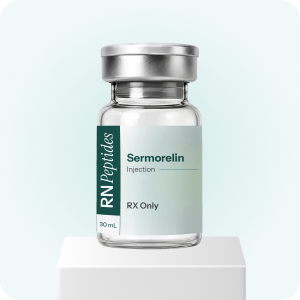
Sermorelin
- Injectable format listed in the supplier catalog
- Individual review of your health history and goals
- Clear confirmation of formulation, availability, and full pricing
- A nurse practitioner determines whether a prescription is appropriate
A clinician must assess evidence, risks, eligibility, and availability before any treatment decision. Review all applicable fees and terms before you place an order. The How Ordering Works page walks through each step.
Sources
- FDA, Determination That GEREF (Sermorelin Acetate) Injection Was Not Withdrawn From Sale for Reasons of Safety or Effectiveness, Federal Register (2013)
- Liu H, et al. “Systematic Review: The Safety and Efficacy of Growth Hormone in the Healthy Elderly.” Annals of Internal Medicine, 2007
- Cappola AR, et al. “Hormones and Aging: An Endocrine Society Scientific Statement.” Journal of Clinical Endocrinology & Metabolism, 2023
- Tran N. “What Is Sermorelin? Uses, Benefits, Risks, and How It Works.” Policy Lab (July 2026)
- Testing.com, sermorelin benefits and treatment overviews (2026)
- FDA bulk drug substance lists for 503A and 503B compounding
- Frier Levitt peptide compounding analysis (January 2026)
- WADA 2026 Prohibited List
This article offers education alongside, not in place of, medical advice. Talk with a qualified clinician about your health history before any treatment decision.