

Erythropoietin, or EPO, does more than build red blood cells. In the lab it also calms inflammation and helps injured tissue recover. That second talent made EPO an appealing idea for nerve and organ repair. The first talent complicated the picture, because red blood cell mass changes too.
ARA-290, also called cibinetide, is one research group’s answer. It’s a short peptide that keeps the repair message and leaves out the blood-building one. This guide follows that idea from the lab to the clinic. It then shows where the compound stands today.
The Short Version
- ARA-290 is an 11-amino-acid peptide modeled on a piece of EPO’s structure.
- It targets the innate repair receptor, a stress-activated tissue-protection system.
- Human studies ran in sarcoidosis, type 2 diabetes with neuropathy, and diabetic eye disease.
- The safety and regulatory sections hold the evidence limits and the legal picture in full.
The Problem With Erythropoietin
EPO works through two receptor arrangements. Circulating EPO acts through a receptor pair that drives red blood cell production. Locally made EPO helps a second complex, the innate repair receptor.
That repair receptor combines the EPO receptor with the beta common receptor, also called CD131. Inflammation, metabolic stress, and tissue injury switch the system on.
Full-strength EPO activates both systems at once. Researchers wanted the repair effect alone, so they looked for a narrower signal.
Building a Narrower Signal
ARA-290 is modeled on the three-dimensional structure of helix B in the EPO molecule. It’s a linear peptide of 11 amino acids with a molecular weight of about 1,257 daltons. The sequence reads Pyr-Glu-Gln-Leu-Glu-Arg-Ala-Leu-Asn-Ser-Ser.
The design targets the innate repair receptor. That’s why you’ll see it described as non-erythropoietic or nonhematopoietic.
What the Repair Receptor Does
The diabetes trial authors say injury, inflammation, or metabolic stress induces the receptor. They describe it as mainly an injury response. That idea explains why researchers expect a narrow, injury-focused action.
In animal models, ARA-290 prevented tissue injury, reduced inflammation, and activated healing. Those models included diabetic retinopathy, heart attack, burns, and traumatic brain injury.
In neuropathy models, the peptide reduced underlying inflammation and stimulated nerve fiber regrowth. The effect required the innate repair receptor. Those findings set up the human trials.
A Short Stay in the Bloodstream
After a subcutaneous dose in healthy volunteers, plasma levels peaked in the low nanograms per milliliter. The terminal half-life was about 20 minutes. Some online pages quote other half-life figures. This trial value comes from a measured pharmacokinetic study.
Preclinical data suggest benefits appear once plasma levels pass about 1 nanomole per liter. The clinical trials then tracked outcomes across weeks.
Why Sarcoidosis, Diabetes, and the Eye
The three conditions share a theme. Inflammation and injury can damage the smallest nerves. Sarcoidosis is a chronic inflammatory illness, and small fiber neuropathy is one of its recognized manifestations.
Small fiber neuropathy affects thinly myelinated and unmyelinated fibers. Damage causes burning pain, tingling, or numbness, usually starting in the feet. That shared pattern explains why one repair idea reached several study populations.
The Trial Record, Study by Study
Human research on ARA-290 came in several waves.
The 2012 pilot. Twenty-two people with sarcoidosis and small fiber neuropathy symptoms joined a double-blind trial. Twelve received intravenous ARA-290 three times weekly, and ten received placebo, for four weeks. The treated group improved more than placebo on a small fiber neuropathy screening list.
The 2013 follow-up. A single-site, blinded, placebo-controlled study ran for 28 days of daily subcutaneous dosing. It reported better neuropathic symptoms, corneal nerve fiber density, temperature sensitivity, and six-minute walk distance.
The 2017 phase 2b trial. A registered trial randomized 64 people with sarcoidosis-related nerve fiber loss. They joined one of three treatment groups or a placebo group. One tested group improved on the primary corneal nerve fiber endpoint. A skin regeneration marker also changed. The ClinicalTrials.gov record describes the design.
The 2015 diabetes trial. The next section covers it in detail.
The 2020 eye pilot. An open-label phase 2 pilot enrolled nine people with diabetic macular edema. They received daily subcutaneous cibinetide for 12 weeks. Eight completed it. That study extended the research beyond peripheral nerves.
Inside the Diabetes Trial
The 2015 trial deserves a close look because it combined metabolic and nerve measures. It was double-blind and placebo-controlled, and it was registered in the Netherlands Trial Register. Sixty-one people were screened, and 49 enrolled. Participants self-injected daily for 28 days and were followed for another month.
Everyone kept their usual diabetes and pain medicines during the study. Read the full trial paper.
This table shows the headline results.
| Measure | ARA-290 Group | Placebo Group |
| Change in HbA1c at day 56 | Down 0.21 percentage points | Up 0.21 percentage points |
| PainDetect improvement at day 56 | 4.2 points | 0.74 points |
| Corneal nerve fibers, affected subgroup | Up 2.6 fibers per square millimeter | Up 0.7 |
Cholesterol-to-HDL ratio and triglycerides also improved with ARA-290. Tingling, thermal pain, and allodynia scores improved significantly. Physical role functioning and vitality scores rose on the quality-of-life survey.
In the affected subgroup, the nerve fiber change tracked the symptom change. That link supports the idea that structure and symptoms move together.
The team sized the trial from the earlier sarcoidosis study. It aimed for 40 evaluable participants and enrolled extra to allow for withdrawals.
What the authors concluded. They wrote that ARA 290 shows significant potential for diabetic small fiber neuropathy. They said longer treatment in less well-controlled patients could produce larger changes. They called for continued clinical evaluation.
Corneal Nerves as a Window Into Small Fibers
Small nerve fibers are hard to count. Researchers use corneal confocal microscopy, a noninvasive eye scan, as a practical window. At baseline, the diabetes group averaged 24.4 corneal nerve fibers per square millimeter. Healthy controls averaged 37.2.
In the sarcoidosis study, baseline corneal nerve fiber area ran about 50 percent below normal. A measurable gap gives researchers something to track. That’s why corneal nerve density appears in so many of these trials.
How Researchers Score Neuropathic Symptoms
Trial papers use unfamiliar acronyms. Here’s what they mean.
- PainDetect. A validated questionnaire that screens for neuropathic pain components.
- Neuropathic Pain Symptom Inventory. A validated patient-reported measure of pain symptoms.
- Small Fiber Neuropathy Screening List. A list validated in sarcoidosis patients with small fiber symptoms.
- RAND-36. A survey of health-related quality of life.
- Six-minute walk test. A standard measure of walking distance under American Thoracic Society guidelines.
Knowing the tools helps you read any claim about “pain relief” with the right context.
Online Claims and What the Papers Measured
Web pages describe ARA-290 in many ways. This table matches common phrases to the underlying evidence.
| Phrase You May See | What the Papers Measured |
| Regrows nerves | Corneal nerve fiber density in sarcoidosis and in a diabetes subgroup |
| Supports blood sugar | Small HbA1c changes over 56 days in people with good baseline control |
| Works within minutes | A plasma half-life near 20 minutes, with outcomes tracked over weeks |
| Helps the eye | An open-label pilot in nine people with diabetic macular edema |
| Replaces EPO | A peptide designed not to stimulate red blood cell production |
The authors called the HbA1c change small and consistent with other antidiabetic agents in well-controlled patients. That context keeps the number in proportion.
How the Evidence Built Up
- 2004. Researchers described EPO derivatives that protect tissue without driving red blood cell production.
- 2008. A study introduced the helix B peptides derived from EPO’s three-dimensional structure.
- 2012. The first randomized clinical trial enrolled people with sarcoidosis.
- 2013. A 28-day subcutaneous study added corneal nerve measures.
- 2015. A diabetes trial combined metabolic and neuropathic endpoints.
- 2017. The phase 2b results appeared on ClinicalTrials.gov.
- 2020. An open-label pilot examined diabetic macular edema.
Questions Worth Taking to a Specialist
Neuropathy deserves a proper diagnosis. A neurologist or endocrinologist can sort out the cause and the options.
- What’s causing my symptoms, and what tests confirm it?
- Which approved treatments fit my diagnosis?
- How does the ARA-290 research apply to my situation?
- Which of my medicines or conditions change the plan?
- How will we measure progress, and over what timeframe?
- What would a quality-tested product look like, and who would prepare it?
ARA-290 Safety Information
This section gathers the safety information in one place. It covers the trial record, the serious events, the evidence limits, and who needs extra caution.
What the Trials Recorded
In the diabetes trial, hematology and clinical chemistry showed no clinically significant changes after ARA-290. Antibody tests were negative at baseline and at day 28. Adverse events occurred at similar frequency in both groups.
The ARA-290 group recorded 54 mild, 9 moderate, and 1 severe event. The placebo group recorded 61 mild and 5 moderate events.
Details Behind the Serious Events
Four serious adverse events occurred in the ARA-290 arm. Two were judged possibly related, and two unlikely related.
One participant took furosemide, and the dose rose after week two. Borderline kidney function worsened, and the safety committee stopped ARA-290. Kidney function didn’t improve over six weeks of follow-up.
Another participant, a 70-year-old man, developed severe cellulitis two weeks after his last dose. He was hospitalized and had a fatal myocardial infarction. The safety committee judged that event unrelated to ARA-290.
Limits on What the Studies Can Say
The diabetes trial lasted only 28 days, and participants had generally excellent glycemic control. Several secondary measures showed no group difference, including the screening list and quantitative sensory testing. Both groups improved on one pain inventory at day 28.
Three of the authors are officers of the developing company and own stock or options. One preclinical study cited in the paper is marked as retracted in its reference list.
Reviews of the program say durable benefit and independent replication remain open. Comparisons with other treatments remain open too. No phase 3 trial of ARA-290 has been reported in the sources reviewed here.
Who Needs Extra Caution
Anyone with kidney disease or on a diuretic needs a clinician first. Anyone with heart disease, diabetes, or a history of blood clots needs a clinician first too. Skip use during pregnancy, while nursing, or under age 18 unless a qualified specialist authorizes it.
Seek urgent care for chest pain, sudden swelling, trouble breathing, or injection-site infection signs.
ARA-290 Regulatory Status and Product Safety
This section reflects the sources checked as of October 27, 2026. It covers FDA status, how the compound reaches the market, anti-doping rules, and product quality.
Where ARA-290 Stands
One research library describes ARA-290 as an investigational drug under clinical development. A compounding pharmacy’s page adds that compounded medications aren’t FDA-approved.
FDA’s compounding safety page, current as of April 22, 2026, doesn’t list ARA-290 among its entries. That absence isn’t an approval. No FDA-approved ARA-290 product exists.
Ask any provider, including us, for the legal basis, the dispensing pharmacy, and the exact form.
How It Reaches the Market
A 503A compounding pharmacy markets an ARA290 program with reconstitution and dosing guidance. A research supplier sells it for laboratory use only. The label excludes human and veterinary use.
This guide doesn’t reproduce either set of instructions. Pharmacy marketing pages don’t replace a trial protocol or a prescriber’s evaluation.
Anti-Doping Status
WADA’s 2026 Prohibited List includes innate repair receptor agonists under S2.1.5. Earlier lists named ARA-290 itself as a non-erythropoietic EPO-receptor agonist. Substances in S2 are prohibited at all times. Athletes subject to testing can face sanctions.
Product Quality and Sourcing
Pages differ on basic facts. One library lists a molecular weight near 1,257. Another listing shows 1,259.34, and their molecular formulas differ. Half-life figures vary across pages as well. Confirm the exact form, preparing pharmacy, and testing documents before any treatment decision.
What “Research Use Only” Means
Products sold online “for research use only” aren’t approved or quality-controlled for human use. Vendor vials can differ from pharmacy-dispensed products in identity, sterility, and strength. Confirm all three with the dispensing pharmacy.
RN Peptides lists many investigational compounds for discussion only. A listing doesn’t imply approval for human use, and it doesn’t guarantee availability.
Using This Guide Safely
This guide is education. It doesn’t provide dosing, reconstitution, or injection instructions. A prescriber sets any dose after an evaluation. Report suspected side effects through FDA’s MedWatch program. Talk with a qualified clinician about your health history before any treatment decision.
ARA-290 Questions People Ask
What is ARA-290 used for?
Researchers have studied it in sarcoidosis neuropathy, diabetic neuropathy, and diabetic macular edema. The trial sections cover each one.
How long does it take ARA-290 to start working?
The trials measured outcomes at 28 days and, in the diabetes study, at day 56. In that study, symptom improvement grew between the two time points.
Can you take ARA-290 and BPC-157 together?
The studies reviewed here examined ARA-290 alone. A clinician can review any combination for your situation.
How many people joined the diabetes trial?
Sixty-one people were screened, 49 enrolled, and 48 were analyzed. Each group held 24 participants.
What does cibinetide mean?
Cibinetide is another name for ARA-290. Both names describe the same 11-amino-acid peptide.
Is ARA-290 the same as EPO?
No. It’s modeled on a piece of EPO and designed to avoid red blood cell stimulation.
Does ARA-290 raise red blood cell counts?
It was designed to leave red blood cell production alone. The diabetes trial reported stable hematology results.
What is small fiber neuropathy?
It’s a nerve disorder of the thinnest sensory fibers. It often brings burning, tingling, or numbness in the feet and hands.
Who developed ARA-290?
Officers of Araim Pharmaceuticals co-authored the diabetes trial. The company developed the peptide.
What does Pyr mean in the sequence?
It marks a pyroglutamate cap on the N-terminus.
What is the innate repair receptor?
It’s a stress-activated receptor complex of the EPO receptor and CD131. It mediates a tissue-protection response.
Which conditions did the human trials cover?
They covered sarcoidosis-related small fiber neuropathy, type 2 diabetes with neuropathy, and diabetic macular edema.
Does ARA-290 help with nerve pain?
The trials reported improved neuropathic symptom scores in some groups. The safety section lists where results were similar across groups.
Is ARA-290 FDA approved?
The regulatory section explains its status in detail.
Is ARA-290 legal in 2026?
The regulatory section covers compounding, research-use sales, and sport. Ask any provider for the legal basis.
Is ARA-290 banned in sports?
The regulatory section covers WADA’s current list.
What are the side effects of ARA-290?
The safety section lists what the trials recorded and what led one participant to stop.
How is ARA-290 dosed?
A prescriber sets the dose after an evaluation. This guide focuses on education.
Where can I read the original studies?
The Sources list links the diabetes trial, two earlier studies, and the registry entry.
Bring Your ARA-290 Questions to RN Peptides
If you’re exploring neuropathy or nerve-health questions, our nurse practitioners can talk it through. Bring your history, your medicines, and what you’ve read.
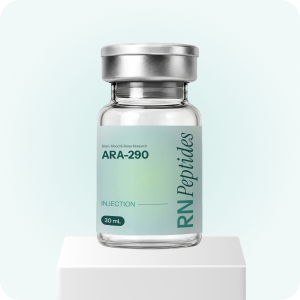
ARA-290
- Injectable format listed in the supplier catalog
- Individual review of your health history and goals
- Clear confirmation of formulation, availability, and full pricing
- Prescription required, with licensed nurse practitioner review
A clinician assesses evidence, risks, eligibility, and availability before any treatment decision. Review all applicable fees and terms before you place an order. The How Ordering Works page walks through each step.
Sources
- Brines M, et al. ARA 290, a nonerythropoietic peptide engineered from erythropoietin, improves metabolic control and neuropathic symptoms in patients with type 2 diabetes. Molecular Medicine, 2015
- Heij L, et al. Safety and efficacy of ARA 290 in sarcoidosis patients with symptoms of small fiber neuropathy, a randomized, double-blind pilot study. Molecular Medicine, 2012
- Dahan A, et al. ARA 290 improves symptoms in patients with sarcoidosis-associated small nerve fiber loss and increases corneal nerve fiber density. Molecular Medicine, 2013
- ClinicalTrials.gov, Study of efficacy of ARA 290 on corneal nerve fiber density and neuropathic symptoms of subjects with sarcoidosis (NCT02039687)
- FDA, Certain Bulk Drug Substances for Use in Compounding That May Present Significant Safety Risks (content current April 22, 2026)
- The 2026 Prohibited List, World Anti-Doping Code, Dutch treaty series
- WADA, Prohibited List
- Lois N, et al. A phase 2 clinical trial on the use of cibinetide for the treatment of diabetic macular edema. Journal of Clinical Medicine, 2020
This article offers education alongside, not in place of, medical advice. Talk with a qualified clinician about your health history before any treatment decision.