
AOD-9604 is one of the most studied fat-metabolism peptides in the wellness world. It has a clear design story, a well-described lab record, and a large human trial program.
You’ll see how AOD-9604 was designed and what the studies measured. You’ll also see how it compares with other peptides. You’ll learn how to prepare for a clinician visit. The safety sections hold the full FDA picture and the trial results.
The Quick Answer. AOD-9604 is a 16-amino-acid peptide built from a fragment of human growth hormone. An Australian company developed it to isolate the hormone’s fat-metabolism activity. About 900 participants took part in six placebo-controlled trials, and researchers reported tolerability similar to placebo. The safety sections cover the weight-loss results and FDA’s position in full.
AOD-9604 at a Glance
This snapshot covers the essentials. Each row points to a section below.
| Item | Snapshot |
| Type | Synthetic hexadecapeptide, 16 amino acids |
| Origin | A growth hormone fragment with an added tyrosine |
| Developer | Metabolic Pharmaceuticals, Australia |
| Proposed Action | Fat breakdown without growth hormone receptor activity |
| Human Research | Six randomized, placebo-controlled studies |
| Latest FDA Step | Advisory committee review on December 4, 2024 |
What Is AOD-9604?
AOD-9604 is a hexadecapeptide, a chain of 16 amino acids. It’s a synthetic fragment of human growth hormone, residues 177 to 191. An added tyrosine sits at one end. Two cysteines form a disulfide bridge that gives the peptide a ring shape.
Metabolic Pharmaceuticals developed and patented it in the late 1990s. The name began as shorthand for an anti-obesity drug. Some sources describe the fragment as 176 to 191. FDA’s review uses 177 to 191 plus tyrosine, and this guide follows it.
How AOD-9604 Is Thought to Work
Researchers describe the proposed action in four steps.
- The peptide reaches fat tissue.
- Fat cells break down stored fat, a process called lipolysis.
- Fat cells make less new fat, a process called lipogenesis.
- Fatty acid oxidation rises.
In cell assays, AOD-9604 left growth hormone receptor binding unaffected. That helps explain why researchers describe it as separate from the growth hormone axis. In obese rodents, it left plasma glucose and insulin unchanged.
Beta-3 Receptors and the Proposed Pathway
In mice lacking beta-3 adrenergic receptors, the weight-gain effect disappeared. In normal obese mice, it raised beta-3 receptor expression in white and brown fat. Those findings point to beta-3 signaling as one route for its lipolytic effects.
Beta-3 receptors sit mainly on fat cells. That’s why the proposed action centers on adipose tissue.
What the Animal Studies Show
In obese Zucker rats, 19 days of oral dosing cut weight gain by over 50 percent. Fat tissue from treated rats showed higher lipolytic activity. Chronic treatment had no adverse effect on insulin sensitivity.
In obese ob/ob mice, 14 days of treatment produced 5 to 10 percent less weight gain. Food intake didn’t explain the difference, and fat oxidation rose. Treated animals also had less white and brown fat.
What Human Studies Exist?
Six randomized, double-blind, placebo-controlled studies make up the human program. This table shows each one.
| Study | Who | Route and Length |
| METAOD001 | 15 men | IV, single doses |
| METAOD002 | 23 men with obesity | IV, single doses, four sessions |
| METAOD003 | 17 men with obesity | Oral, three dose levels |
| METAOD004 | 36 men with obesity | Oral, 7 days |
| METAOD005 | 300 adults with obesity | Oral, 12 weeks |
| METAOD006 (OPTIONS) | 536 enrolled, 502 randomized | Oral, 24 weeks |
In the 12-week study, mean weekly weight loss ran higher than placebo at every dose. Waist circumference fell more than placebo at every dose. The abstract also reported small cholesterol drops. The OPTIONS results appear in the safety section.
AOD-9604 Research Timeline
This table lines up the key studies and decisions.
| Year | Milestone |
| Late 1990s | Metabolic Pharmaceuticals develops and patents AOD-9604 |
| 2000 | A rat study reports the metabolic effects of oral dosing |
| 2001 | Mouse studies describe fat oxidation and the beta-3 pathway |
| 2005 | A meeting abstract reports the 12-week trial |
| 2007 | The sponsor reports OPTIONS results |
| September 2024 | AOD-9604 leaves FDA’s Category 2 list |
| December 2024 | An FDA advisory committee reviews AOD-9604 |
AOD-9604 Research by Goal
This table matches each goal to its evidence.
| Goal | Evidence Type | What You Can Say |
| Fat Metabolism | Rodent studies | Documented in animals |
| Insulin Sensitivity | Rodent studies and human lab checks | Neutral in the studies reviewed |
| Waist Circumference | One 12-week trial abstract | Reported reduction |
| Weight Change | Six human studies | Results appear in the safety section |
| Joint Health | One rabbit knee model | Early-stage |
Tolerability in the Human Trials
The trials monitored vital signs, labs, ECGs, and IGF-1. The authors reported no statistically significant IGF-1 differences between treatment and placebo groups. They also reported no significant changes in lab values, ECGs, or vital signs.
Antibody tests in selected participants found no antibodies against the peptide. The sponsor-funded authors described adverse event patterns as similar to placebo. The safety section covers the details that FDA’s reviewers highlighted.
AOD-9604 vs. Tesamorelin and Growth Hormone Secretagogues
AOD-9604 works differently from the growth hormone-axis peptides. This table shows the contrast.
| Option | Class | How It Works |
| AOD-9604 | Growth hormone fragment | Proposed direct action on fat cells |
| Tesamorelin | GHRH analog | Prompts the pituitary to release growth hormone |
| Ipamorelin | Secretagogue | Acts on the ghrelin receptor |
| CJC-1295 | GHRH analog | Prompts the pituitary to release growth hormone |
Forms and Routes, Why They Matter
Clinics market AOD-9604 as injections, oral capsules, troches, and creams. The human studies used oral and IV routes. This table shows what to ask.
| Form | Research Context | What to Ask |
| Oral Capsule | Rodent, pig, and human studies | Does the product match the studied route? |
| IV | Two early human studies | Who administers it, and why? |
| Subcutaneous Injection | Marketed by clinics | Which evidence covers this route? |
| Transdermal Cream | Marketed by clinics | Which evidence covers this route? |
Each route has its own evidence. Match the product to the study.
How to Read AOD-9604 Claims
Fat-loss claims deserve careful questions. Use this list.
- Does the claim cite a human trial, an animal study, or a seller’s page?
- Which route and dose form did the study use?
- Which outcome did researchers measure, and over how many weeks?
- Does the page name the exact peptide, including the added tyrosine?
- Who sells the product, and who dispensed it?
A rodent result describes rodents. A human result describes the population enrolled.
Building the Foundation
Researchers and clinicians agree on the basics. Meaningful body-composition change depends on a calorie deficit and resistance training. Sleep, protein intake, and stress management support the same goal.
A clinician or dietitian can tailor each habit to you. Those habits shape results with any plan you choose.
Who Should Talk With a Clinician About Body Composition?
An evaluation helps most when your goals are specific.
- Adults interested in body composition or metabolic health. A clinician helps you set goals that match the evidence.
- People managing diabetes, thyroid conditions, or heart conditions. Individual planning opens the safest options.
- Adults comparing approved weight-management medicines. A clinician can walk you through each one.
- Athletes who want to protect their eligibility. An anti-doping resource gives current rules.
Tracking Your Progress
Good tracking beats good guesses. Clinicians often use body-composition scans, waist measurements, and regular weigh-ins. They also review blood sugar, lipids, and blood pressure. Your clinician sets your schedule.
- Weight, measured the same way each week.
- Waist and hip measurements.
- A body-composition scan if your clinician advises one.
- Labs your clinician orders.
Choosing a Provider and Pharmacy
Good providers answer these questions clearly.
- Which FDA-approved options fit my goals?
- Which pharmacy prepares or dispenses the product?
- What licensed clinician oversight is involved?
- How often is follow-up scheduled?
- How are side effects managed?
Verify each clinician’s license with the Texas boards. Verify the pharmacy’s license with the Texas State Board of Pharmacy. Ask for the answers in writing.
Documents to Request
Good documentation answers practical questions. Look for these items on your label and paperwork.
- The exact peptide name and form.
- The preparing pharmacy’s name and license.
- A lot number and a beyond-use date.
- Storage instructions for your exact product.
- Testing documents from the pharmacy or manufacturer.
Reported storage guidance varies by form and temperature. Follow your pharmacy label for your exact product.
Questions to Bring to Your Clinician
Walk into the appointment with your questions written down.
- What’s my goal, and what approved options fit it?
- What does the evidence show for AOD-9604?
- Which exact form and route are we discussing?
- Which pharmacy prepares it, and how does it document quality?
- Do my medicines or conditions change the plan?
- How will we measure progress, and when do we reassess?
- What’s the full cost, including follow-up?
A good clinician welcomes these questions.
AOD-9604 Safety Information
This section gathers the safety information in one place. Three parts cover the clinical record, what FDA’s review found, and what researchers are still learning.
What the Clinical Record Shows
The largest trial, OPTIONS, tested oral AOD-9604 for 24 weeks. It enrolled 536 adults with obesity and randomized 502. The primary endpoint was weight loss at 12 weeks. Weight loss versus placebo wasn’t statistically significant.
On February 21, 2007, the sponsor said the results didn’t support commercial viability. It ended development for obesity. The trial results weren’t published in the medical literature.
Earlier IV and oral studies found no statistically significant weight loss versus placebo. The 12-week study is known only through a meeting abstract with limited detail. FDA concluded the evidence doesn’t support effectiveness for obesity by any route.
What FDA’s Review Found
Common adverse events in the oral studies included headache, diarrhea, and flatulence. The IV studies reported headache, fatigue, low blood sugar, and dizziness. Chest tightness and euphoria were possibly related to the peptide.
Five cancers occurred in the 12-week study, and the investigators judged them unrelated. FDA said the available information is insufficient to confirm that. FDA’s adverse event database held no AOD-9604 reports through January 2024. Its reviewers noted that a lack of reports doesn’t show safety.
FDA found no pharmacokinetic studies in humans by any route. It found no human exposure data for subcutaneous or topical use.
In a six-month rat study, serum osteocalcin changed with dose. That could signal an effect on bone. In a nine-month monkey study, some animals had minimal periportal vacuolation in the liver. Genotoxicity results were equivocal. FDA found no reproductive or carcinogenicity studies.
FDA also raised immunogenicity and aggregation concerns. It noted that subcutaneous injection raises them more than IV.
Skip use during pregnancy, while nursing, or under age 18 unless a qualified clinician authorizes it. An active cancer or a history of malignancy calls for medical review first. Seek prompt care for chest tightness, hives, facial swelling, or trouble breathing.
What Researchers Are Still Learning
FDA says AOD-9604’s molecular targets and mechanisms remain unknown. It found no nonclinical data to support claims that AOD-9604 leaves IGF-1 unchanged. The dose-response relationship for weight loss was never established in the animal studies.
Long-term safety data for chronic use are missing. The trial summaries lacked detail on adverse events and lab values.
AOD-9604 Regulatory Status and Product Safety
This section reflects the sources checked as of October 23, 2026. Four parts cover FDA’s position, product quality, the research-use label, and safe use of this guide.
Where FDA Stands
| Topic | Status as of October 23, 2026 |
| FDA-Approved Use | None |
| Part of an Approved Drug | No |
| USP Drug Monograph | None |
| Category 2 List | Removed in September 2024 after nominations were withdrawn |
| FDA Staff Review (November 2024) | Proposed not adding it to the 503A bulks list |
| Advisory Vote (December 4, 2024) | 0 yes, 12 no for the free base and acetate |
| 503A Compounding Path | None at present |
| Anti-Doping | WADA lists AOD-9604 as prohibited |
AOD-9604 isn’t a component of an FDA-approved drug, and no USP monograph covers it. The advisory committee voted 0 to 12 against placing it on the 503A bulks list. FDA’s evaluation covered obesity only.
No outsourcing facility reported compounding AOD-9604 from 2017 through 2023. FDA found medical spas and wellness clinics marketing it for many uses, from osteoarthritis to anti-aging.
WADA lists AOD-9604 as prohibited, so athletes subject to testing can face sanctions. Australia restricts possession without authority.
Ask any provider, including us, for the legal basis, the dispensing pharmacy, and the exact form.
Product Quality and Naming
FDA found that certificates of analysis for AOD-9604 often lack impurity limits. They also lack aggregate and endotoxin tests. One nomination named the free base while its certificate described the acetate. FDA also found inconsistent CAS numbers and structures on supplier sites.
Vendor pages sometimes call AOD-9604 generally recognized as safe. FDA staff said at the 2024 meeting that it isn’t on FDA’s GRAS list.
What “Research Use Only” Means
Products sold online “for research use only” aren’t approved or quality-controlled for human use. Vendor vials can differ from pharmacy-dispensed products in identity, sterility, and strength. Confirm all three with the dispensing pharmacy.
RN Peptides lists many investigational compounds for discussion only. A listing doesn’t imply approval for human use, and it doesn’t guarantee availability.
How to Use This Guide Safely
This guide is education. It doesn’t provide dosing, reconstitution, or injection instructions. A prescriber sets any dose after an evaluation. Report suspected side effects through FDA’s MedWatch program. Talk with a qualified clinician about your health history before any treatment decision.
Frequently Asked Questions About AOD-9604
Here are short answers to the most common questions. Each one points back to the detail above.
What Is AOD-9604?
It’s a 16-amino-acid peptide built from a growth hormone fragment. It was designed to isolate fat-metabolism activity.
What Does AOD-9604 Do?
Researchers propose it promotes fat breakdown and lowers fat formation. The animal studies support that proposal.
Does AOD-9604 Cause Weight Loss?
It was designed to promote fat breakdown. The human weight-loss results appear in the safety section.
Is AOD-9604 a Growth Hormone?
No. It’s a fragment of growth hormone. In cell assays, it left growth hormone receptor binding unaffected.
Does AOD-9604 Raise IGF-1?
The human trial authors reported no significant IGF-1 differences. The safety section covers FDA’s comment.
Is AOD-9604 Safe?
The safety section lists what trials and FDA’s review found.
Is AOD-9604 FDA Approved?
The regulatory section lists FDA’s position in detail.
Is AOD-9604 Legal in 2026?
The regulatory section explains compounding status and sourcing. Ask any provider for the legal basis.
How Does AOD-9604 Differ From Tesamorelin?
Tesamorelin prompts growth hormone release and has an approved use in HIV lipodystrophy. AOD-9604 is a fragment proposed to act on fat cells.
How Long Does AOD-9604 Take to Work?
The trials measured weight at 12 and 24 weeks. The safety section has those results.
Can AOD-9604 Be Taken by Mouth?
The human trials used oral dosing. Animal studies found oral activity too.
How Is AOD-9604 Dosed?
A prescriber sets the dose after an evaluation. This guide focuses on education.
Can AOD-9604 Be Combined With Other Peptides?
Clinics market combinations. The studies in this guide examined AOD-9604 alone.
Is AOD-9604 Banned in Sports?
The regulatory section covers anti-doping status.
What Are the Side Effects of AOD-9604?
The safety section lists the effects reported in the trials.
Can I Buy AOD-9604 Online?
A clinician and a licensed pharmacy are the safer route. The regulatory section explains research-use products.
Where Can I Learn More?
Start with FDA’s December 2024 briefing document and the 2000 rat study in Hormone Research.
Talk With RN Peptides About Body Composition
If you’re exploring metabolic or body-composition goals, our team can talk it through. Bring your history, your medicines, and your questions.
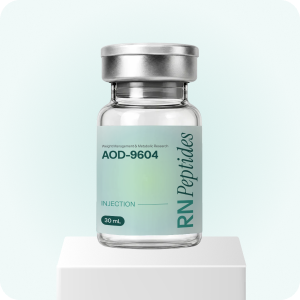
AOD-9604
- Injectable format listed in the supplier catalog
- Individual review of your health history and goals
- Clear confirmation of formulation, availability, and full pricing
- Prescription required, with licensed nurse practitioner review
A clinician assesses evidence, risks, eligibility, and availability before any treatment decision. Review all applicable fees and terms before you place an order. The How Ordering Works page walks through each step.
Sources
- FDA, Briefing Document on AOD-9604-Related Bulk Drug Substances, Pharmacy Compounding Advisory Committee (December 4, 2024)
- FDA, Final Summary Minutes, Pharmacy Compounding Advisory Committee (December 4, 2024)
- Ng FM, et al. “Metabolic studies of a synthetic lipolytic domain (AOD9604) of human growth hormone.” Hormone Research, 2000
- Heffernan MA, et al. AOD9604 and fat oxidation in obese mice. International Journal of Obesity, 2001
- Stier H, et al. Safety and tolerability of AOD9604 across six clinical studies (2013)
- WADA Prohibited List
This article offers education alongside, not in place of, medical advice. Talk with a qualified clinician about your health history before any treatment decision.