

Cardiogen is a very short peptide studied for effects on heart and connective tissue cells. It has four amino acids and a history in Russian gerontology research. It also appears often in online peptide discussions. The published record centers on cell and animal work.
This guide explains what Cardiogen is and how researchers believe it acts. It reviews the existing studies and defines their terms. It also clarifies what remains to be tested. It closes with the regulatory picture for 2026.
Cardiogen at a Glance
| Item | Detail |
| Sequence | Ala-Glu-Asp-Arg, also written AEDR |
| Type | Synthetic tetrapeptide of the bioregulator class |
| Molecular Formula | C18H31N7O9 |
| Molecular Weight | About 489.5 g/mol |
| Origin | Peptide bioregulator research led by Vladimir Khavinson |
| Research Stage | Cell culture, tissue culture, and animal studies |
| FDA Status | No approved product |
A Plain-Language Glossary
The research literature uses specialized terms. This table defines the ones that appear in this guide.
| Term | Meaning |
| Peptide Bioregulator | A very short peptide proposed to influence gene activity in particular tissues |
| Cardiomyocyte | A heart muscle cell |
| Fibroblast | A connective tissue cell that helps form scar tissue |
| Cytoskeleton | The internal scaffold that gives a cell its shape |
| Nuclear Matrix | The scaffold inside the cell nucleus |
| Apoptosis | Programmed cell death |
| Preclinical | Research done in cells or animals before human trials |
Where Cardiogen Comes From
Researchers at the St. Petersburg Institute of Bioregulation and Gerontology identified Cardiogen through peptide bioregulator programs. The group studied short peptides that they proposed act in a tissue-specific way.
Cardiogen belongs to a family of short peptides developed by that laboratory. Each member is associated with a target organ. Cardiogen’s association is with cardiac tissue.
Why Researchers Study Short Peptides
Short peptides offer practical advantages. They’re simple to make by chemical synthesis. They’re easy to describe by sequence. The Khavinson laboratory reports that its peptides act in a tissue-selective manner.
That selectivity is the idea behind the bioregulator concept. It remains a proposal under test, and Cardiogen is one example.
What Cardiogen Is
Cardiogen contains four amino acids. Alanine, glutamic acid, aspartic acid, and arginine form its sequence.
Epitalon, a relative, has the sequence Ala-Glu-Asp-Gly. The two peptides differ by one amino acid at the end. Despite the similarity, each has its own research record and its own target tissue.
The four building blocks are shown below.
| Position | Amino Acid | Abbreviation |
| 1 | Alanine | Ala |
| 2 | Glutamic Acid | Glu |
| 3 | Aspartic Acid | Asp |
| 4 | Arginine | Arg |
How Cardiogen Is Proposed to Work
Researchers propose that Cardiogen influences which proteins a cell makes. The proposed mechanism does not involve a classic cell-surface receptor. Instead, the peptide is thought to act inside the cell.
Researchers are still mapping where the peptide binds inside cells. The mechanism remains a hypothesis, and the experimental findings are the stronger evidence.
What a Cell Does With Its Scaffold
Every cell maintains an internal framework. The cytoskeleton supports the cell’s shape and helps it divide. Actin, tubulin, and vimentin are three cytoskeletal proteins.
A second framework lies inside the nucleus. Lamin A and lamin C are nuclear matrix proteins. Researchers measure these proteins as signs of how a cell builds and maintains its structure.
Reading the Term Fold Change
Studies often report results as fold changes. A fold change states how many times higher a measurement is than the control. A two-fold rise means the level doubled.
The 2012 abstract reports two- to five-fold changes for the cytoskeletal proteins. It reports two- to three-fold changes for the nuclear matrix proteins. Those numbers describe cultured cells.
The Core Experiment, Step by Step
The best-documented study measured proteins in cultured cells. Its 2012 title is “Tetrapeptide H-Ala-Glu-Asp-Arg-OH Stimulates Expression of Cytoskeletal and Nuclear Matrix Proteins.”
- Researchers grew mouse embryonic fibroblasts in culture.
- They exposed some cultures to the tetrapeptide.
- They measured cytoskeletal proteins, including actin, tubulin, and vimentin.
- They measured nuclear matrix proteins, including lamin A and lamin C.
- They compared the results with untreated cultures.
Cytoskeletal proteins rose two to five times in treated cultures. Nuclear matrix proteins rose two to three times. The authors concluded this activity stimulates cell proliferation and reduces apoptosis.
What this means for readers is specific. The finding shows a change in protein production in one type of cultured cell. Studies in living tissue address the next question. Read the 2012 study.
Cardiac Tissue Studies in Rats
A separate report examined heart tissue directly. Its title names amino acids, Cardiogen, and tissue culture from young and old rats.
The summary states that Cardiogen stimulated cell proliferation in myocardial tissue from both age groups. The rats were 3 months old and 24 months old.
Testing tissue from two ages is a useful design. It asks whether the effect persists in older tissue. The result supports further study, and it remains a tissue culture finding.
What Each Type of Study Can Show
Evidence builds in stages. This table shows where Cardiogen’s research sits.
| Stage | What It Tells You | Cardiogen Status |
| Cell Culture | Whether a peptide changes cell behavior | Studied |
| Tissue Culture | Whether the effect appears in intact tissue | Studied |
| Animal Studies | Whether effects occur in a living body | Reported in rodents |
| Human Trials | Whether a benefit and its risks appear in people | Awaiting studies |
Each stage answers a different question and prepares the next one.
A Related Rodent Report
A further study examined Cardiogen in senescent rats with a transplanted tumor. Its title refers to a tumor-modifying effect of Cardiogen on M-1 sarcoma in senescent rats.
The study belongs to the animal stage. It describes an effect in a specific rodent tumor model. It adds to the animal record and points to later study.
Why Cardiac Repair Draws Research
Cardiac repair is a major research question. After injury, cardiac tissue tends to heal through fibrosis rather than regeneration. Scarring preserves structure but can reduce the heart’s pumping function.
That pattern explains why researchers study molecules that act on cardiomyocytes and on fibroblasts. Cardiogen entered the literature through that line of inquiry.
The Broader Research Context
The 2012 authors link Cardiogen’s earlier-reported cardioprotective activity to its effect on structural proteins. That link is the central idea behind the heart-related interest.
A 2021 systematic review covers peptide regulation of gene expression more broadly. It frames the wider field of short peptide research.
Not to Be Confused With CardioGen-82
The name Cardiogen also belongs to an unrelated medical product. CardioGen-82 is a rubidium Rb 82 generator used to produce an injection for cardiac imaging. The injection is a radioactive diagnostic agent used for PET scans of heart blood flow.
That product is unrelated to the peptide. It has its own FDA labeling and its own safety warnings. Readers searching for either one should confirm which they mean.
Common Claims and What Would Support Them
Online pages describe Cardiogen with strong language. This table shows the evidence that would support each common claim.
| Claim | What Would Support It |
| Regenerates heart muscle | Imaging and function studies in animals, then human trials |
| Lowers blood pressure | Controlled human trials with blood pressure measurements |
| Reduces scar tissue | Measured scar size in injury models, then human data |
| Improves endurance | Controlled exercise trials in people |
| Acts selectively on tumor cells | Comparison of tumor and normal cells in controlled studies |
| Is well tolerated | Safety data from human studies |
A claim gains weight as it moves from cells to animals to people.
Foundations of Heart Health
Established care remains the base of cardiovascular health. Blood pressure control, cholesterol management, and blood sugar control all matter. Regular physical activity, tobacco avoidance, and good sleep also support the heart.
A clinician can assess cardiovascular risk with a history, an examination, and laboratory tests. Those steps identify conditions and guide treatments with proven benefit.
Questions to Ask a Supplier or Pharmacy
Product documentation answers practical questions. These questions help organize the conversation.
- Which exact peptide and form does the product contain?
- Which pharmacy prepares it, and what is its license?
- Which tests verify identity, purity, and sterility?
- Which lot number and expiration date appear on the label?
- Which storage instructions apply to this exact product?
How This Guide Weighs Sources
This guide gives the most weight to original studies and to FDA and WADA documents. It treats product pages and clinic pages as claims to verify. Where a claim lacks a published study behind it, the guide leaves it out.
That approach keeps each statement tied to evidence a reader can check.
Questions Worth Taking to a Clinician
A productive visit starts with a clear goal. These questions help structure it.
- What’s my cardiovascular risk, and which tests measure it?
- Which established treatments fit my situation?
- Does the Cardiogen research apply to my condition?
- Which exact product are we discussing, and who prepares it?
- How do my medicines and conditions change the plan?
- How will we measure progress, and when do we reassess?
Cardiogen Safety Information
This section gathers the safety information in one place. It covers the human evidence, the research limits, and FDA’s view of a close relative. It ends with precautions.
The Human Evidence
The sources reviewed include no controlled human trials of Cardiogen. The published work consists of cell culture, tissue culture, and animal studies. The commercial pages reviewed don’t cite human trials for their benefit claims.
For that reason, no safety profile in people can be described. Side effect rates, interactions, and long-term effects are unknown.
Limits of the Research
The Cardiogen reports reviewed come from the laboratory network that developed the peptide. The sources reviewed don’t document independent replication. The binding sites and the mechanism aren’t fully characterized.
The 2012 study used mouse embryonic fibroblasts. Those cells differ from adult human heart cells. A result in one cell type doesn’t carry over automatically.
An Open Question About Cell Growth
The 2012 study describes stimulated cell proliferation and reduced apoptosis. Those effects are the reason for the heart-related interest. They also raise a question that no human data answer.
Researchers would need to study how such a peptide behaves in people with a cancer history. Until then, caution is appropriate for anyone with that history.
What FDA Says About a Close Relative
FDA’s safety page doesn’t list Cardiogen. It does list epitalon, the peptide that differs by one amino acid. FDA says compounded drugs containing epitalon may pose a risk for immunogenicity by certain routes.
FDA also lacks sufficient information to know whether epitalon would cause harm in humans. A relative’s entry isn’t a ruling on Cardiogen, and it shows what FDA looks for.
Why Self-Treatment Carries Risk
Cardiovascular self-treatment is high risk and can delay urgent care. A peptide with no human trials can’t replace evaluation or established medicines.
Chest pain, shortness of breath, fainting, or a racing heartbeat need prompt medical care. Don’t postpone an evaluation to try an unproven product.
Who Needs Extra Caution
Anyone with heart disease, high blood pressure, or a rhythm disorder needs a clinician first. People taking cardiac medicines need the same step. A cancer history calls for the same step.
Skip use during pregnancy, while nursing, or under age 18 unless a qualified specialist authorizes it. Seek urgent care for hives, facial swelling, trouble breathing, or injection-site infection signs.
What Researchers Are Still Learning
Researchers still need controlled human trials and independent replication. They also need clearer data on how the peptide acts inside cells. Quality-tested products would support that work. Those steps would turn laboratory findings into answers for patients.
Cardiogen Regulatory Status and Product Safety
This section reflects the sources checked as of October 29, 2026. It covers FDA status, anti-doping rules, and product quality.
Where Cardiogen Stands
| Topic | Status as of October 29, 2026 |
| FDA-Approved Product | None |
| FDA Safety-Risks Page | Doesn’t list Cardiogen |
| Closest Relative | Epitalon appears as a nominated but withdrawn substance |
| Compounding Pathway | None identified in the sources reviewed |
| WADA 2026 S2 Text | Doesn’t name Cardiogen |
The sources reviewed show no FDA approval for Cardiogen. They also show no FDA review entry. Absence from FDA’s page isn’t a clearance. Ask any provider, including us, for the legal basis, the dispensing pharmacy, and the exact form.
Anti-Doping Status
WADA’s 2026 S2 class also covers substances with similar structure or biological effect. The text doesn’t name Cardiogen. Athletes subject to testing should confirm with their anti-doping organization before any use.
Product Quality and Sourcing
Product pages for Cardiogen often carry research-only notices. Those notices state that the material isn’t for human use. Confirm the exact form, the preparing pharmacy, and the testing documents before any treatment decision.
What “Research Use Only” Means
Products sold online “for research use only” aren’t approved or quality-controlled for human use. Vendor vials can differ from pharmacy-dispensed products in identity, sterility, and strength. Confirm all three with the dispensing pharmacy.
RN Peptides lists many investigational compounds for discussion only. A listing doesn’t imply approval for human use, and it doesn’t guarantee availability.
Using This Guide Safely
This guide is education. It doesn’t provide dosing, reconstitution, or injection instructions. A prescriber sets any dose after an evaluation. Report suspected side effects through FDA’s MedWatch program. Talk with a qualified clinician about your health history before any treatment decision.
Cardiogen Questions People Ask
What is Cardiogen peptide?
It’s a synthetic tetrapeptide with the sequence Ala-Glu-Asp-Arg, studied in cell and animal research.
What is Cardiogen peptide used for?
Researchers study it for effects on heart cells and connective tissue cells. The research sections describe the evidence.
Does Cardiogen work?
Cell and tissue culture studies report effects on proliferation and protein production. Human trials would show whether those effects carry over.
Who developed Cardiogen?
Researchers at the St. Petersburg Institute of Bioregulation and Gerontology, led by Vladimir Khavinson.
What is the difference between a tetrapeptide and a protein?
A tetrapeptide has four amino acids. Proteins contain many more and fold into complex shapes.
What is a peptide bioregulator?
It’s a very short peptide proposed to influence gene activity in particular tissues.
What does fold change mean?
It states how many times higher a measurement is than the control. A two-fold rise means the level doubled.
Why do researchers use mouse fibroblasts?
These cells grow reliably in culture. They allow controlled comparisons before more complex studies.
What are fibroblasts?
They’re connective tissue cells that help form scar tissue.
What are cardiomyocytes?
They’re heart muscle cells.
What is apoptosis?
It’s programmed cell death, a normal process in tissues.
How is Cardiogen different from epitalon?
The two differ by one amino acid. Each has its own research record and target tissue.
Is Cardiogen the same as CardioGen-82?
No. CardioGen-82 is a radioactive diagnostic generator for cardiac PET scans. It’s unrelated to the peptide.
Can Cardiogen lower blood pressure?
Human blood pressure trials would answer that question. A clinician can discuss established treatments.
Is Cardiogen safe?
No human safety profile exists. The safety section lists the known limits.
Is Cardiogen FDA approved?
The regulatory section explains its status in detail.
Is Cardiogen legal in 2026?
The regulatory section covers the compounding picture. Ask any provider for the legal basis.
Is Cardiogen banned in sports?
Athletes should confirm with their anti-doping organization. The regulatory section explains the S2 text.
How is Cardiogen dosed?
A prescriber sets the dose after an evaluation. This guide focuses on education.
Where can I read the original studies?
The Sources list links the 2012 study and the 2021 review.
Bring Your Cardiogen Questions to RN Peptides
If you’re exploring heart or cellular health questions, our nurse practitioners can talk it through. Bring your history, your medicines, and what you’ve read. Ask how a product’s identity is documented.
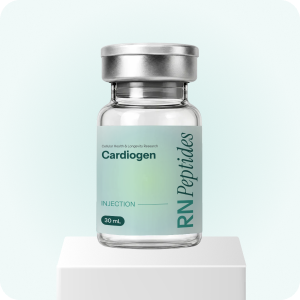
Cardiogen
- Injectable format listed in the supplier catalog
- Individual review of your health history and goals
- Clear confirmation of formulation, availability, and full pricing
- Prescription required, with licensed nurse practitioner review
A clinician assesses evidence, risks, eligibility, and availability before any treatment decision. Review all applicable fees and terms before you place an order. The How Ordering Works page walks through each step.
Sources
- Khavinson VKh, et al. Tetrapeptide H-Ala-Glu-Asp-Arg-OH stimulates expression of cytoskeletal and nuclear matrix proteins. Bulletin of Experimental Biology and Medicine, 2012
- Khavinson VK, et al. Peptide regulation of gene expression, a systematic review. Molecules, 2021
- Khavinson VKh, et al. The effect of the amino acids and Cardiogen on the development of myocard tissue culture from young and old rats
- Khavinson VKh, et al. Tumor-modifying effect of Cardiogen peptide on M-1 sarcoma in senescent rats
- Bracco Diagnostics. CardioGen-82 (rubidium Rb 82 generator), prescribing information highlights
- FDA, Certain Bulk Drug Substances for Use in Compounding That May Present Significant Safety Risks (content current April 22, 2026)
- WADA 2026 Prohibited List, S2 overview (DSHS Cologne)
This article offers education alongside, not in place of, medical advice. Talk with a qualified clinician about your health history before any treatment decision.