

Cartalax is just three amino acids long. Its sequence is alanine, glutamic acid, and aspartic acid, written AED. From that tiny chain, a large reputation has grown. People interested in joints, aging, and recovery follow it closely.
Most of the reputation rests on laboratory work from a Russian research group. Wikipedia notes anti-aging effects in vitro and in animal models. This guide walks through what those experiments measured. It explains how to read the findings. It then shows where the compound stands today.
Quick Facts
- Names. Cartalax, AED, Ala-Glu-Asp, and T-31 all describe one peptide.
- Size. The formula is C12H19N3O8, with a molar mass near 333.
- Origin. It came out of Russian short-peptide research on tissue-specific regulators.
- Evidence. Cell cultures, tissue explants, and animal models make up the core record.
- Cautions. The safety and regulatory sections hold them in full.
One Peptide, Several Names
You’ll see Cartalax listed under different labels. Common synonyms include AED peptide, T-31, and the cartilage bioregulator. Some sellers add a lab reference code, and the sequence stays the same.
One detail trips up many pages. Cartalax is a tripeptide, and a few popular articles call it a dipeptide. The three-residue sequence is the one in the research literature.
Where the Idea Came From
Researchers at the Saint Petersburg Institute of Bioregulation and Gerontology study AED and related short peptides. The program grew from tissue extracts. Early work used polypeptide isolates from calf kidneys that stimulated cell renewal in older rat kidneys.
Chemical analysis then identified Cartalax as one active component. That step turned an extract into a defined three-amino-acid compound that labs could test directly.
What a Cytomedine Is
Cartalax belongs to a class called cytomedines. These are short peptides first identified in animal tissues. They act as organ-specific and tissue-specific signaling molecules.
Clinic pages list cytomedine relatives for the thymus, pineal gland, liver, brain, and cartilage. Researchers describe them as acting in very small amounts. They influence cell signaling rather than acting as hormones.
Why Cartilage Is Hard to Study and Hard to Repair
Cartilage cushions joints and has an unusual biology. It gets nutrients by diffusion rather than a direct blood supply. It also contains relatively few cells, called chondrocytes.
Chondrocytes make collagen, proteoglycans, and the matrix that gives cartilage its structure. The cell population is small. Researchers therefore look for signals that help those cells grow and stay healthy. AED entered cartilage research for that reason.
What Drives Cartilage Change
Researchers track several influences on cartilage health. Inflammatory signals such as IL-1 beta and TNF-alpha stimulate enzymes that act on cartilage matrix. Mechanical stress, aging, metabolic health, and oxidative stress also shape how chondrocytes behave.
That list explains why studies measure inflammation markers, cell numbers, and matrix enzymes together. AED experiments follow the same logic.
How the Culture Experiments Work
Most AED studies use tissue or cells grown in a dish. One 2022 study grew organotypic cultures from young and old rats. Young rats were 2 to 3 months old. Old rats were 16 to 18 months old. It measured the area index of each explant’s growth zone.
Using young and old tissue lets researchers ask whether age changes the response. In the chondrocyte work, both peptides worked better on cells from old animals.
The Cartilage Experiments
Several studies tested AED on cartilage cells or tissue.
Chondrocyte cultures. A 2023 study used primary chondrocytes from young rats and old rats. The young rats were 3 months old, and the old rats were 20 months old. AED raised chondrocyte numbers 1.4 to 1.8 times in young cultures. Old cultures rose 1.6 to 2.1 times. The study also tested a bovine cartilage polypeptide complex.
Cartilage explants. Rat cartilage tissue cultures grew a larger cartilage area. The gain was 18 to 38 percent in young and old animals. The same work reported higher PCNA, a proliferation marker, and lower p53.
Senescence-style markers. In aging chondrocyte cultures, AED normalized synthesis of p16, p21, p53, TNF-alpha, IL-1 alpha, and SIRT1. Those markers describe how aged cells behave in culture.
Beyond Cartilage, Other Lab Systems
The same group tested AED in other cell types. This table lines up the main systems.
| System | What Researchers Measured | Reported Direction |
| Rat Skin Fibroblasts | Proliferation, apoptosis, MMP-9 | More proliferation and less apoptosis in young and aged cultures |
| Human Skin Fibroblasts | SIRT1, SIRT6, collagen I | Higher levels in young and aged cultures |
| Kidney Tissue Cultures | Proliferation and senescence markers | More proliferation, lower p16, p21, and p53, higher SIRT6 |
| Mesenchymal Stem Cells | Gene expression | Changes of 1.6 to 5.6 fold in IGF1, FOXO1, TERT, TNKS2, and NF-kB |
| Testis and Bladder Cultures | Tissue growth | Stimulated cell growth in young and old rat tissue |
| Mouse Kidney Injury Model | Survival | Prevented mortality in a cisplatin-induced injury model |
One reagent supplier notes the MMP-9 reduction appeared in young fibroblast cultures. Read the skin fibroblast study and the kidney culture study.
How Researchers Think It Works
The proposed mechanism is unusual. Researchers in this program suggest that short peptides interact with DNA and chromatin. That interaction would shift which genes a cell reads. In cell models, the peptide moved transcription toward structural protein synthesis.
SIRT6 and p53 form one pair of interest, since p53 can recruit SIRT6 to chromatin. AED raised SIRT6 and lowered p53 in the reported cultures. Read the short peptides and gene expression paper and the stem cell study.
Decoding the Markers
Papers on AED use unfamiliar acronyms. Here’s a plain-language key.
- p16, p21, and p53. These proteins form core parts of the cellular senescence machinery.
- SIRT6. A sirtuin linked to longevity and genomic stability.
- Ki-67 and PCNA. Markers that show cells are dividing.
- MMP-9. An enzyme that breaks down matrix components, with activity rising during aging.
- Caspase-3. An enzyme that carries out programmed cell death.
A change in a marker is a measurement in a dish. It shows what cells did under those conditions.
How the Evidence Built Up
- 2009. An organotypic cartilage culture study measured growth and PCNA.
- 2014. A paper described tripeptides in renal cell culture.
- 2015. Kidney tissue cultures from young and old animals were studied.
- 2016. Skin fibroblast and gene expression papers followed.
- 2019. Researchers studied peptide effects on kidneys in old rats.
- 2020. A stem cell study measured gene expression changes.
- 2022. AED was tested in testis, cortex, and bladder organotypic cultures.
- 2023. A chondrocyte study compared AED with a cartilage polypeptide complex.
The Evidence Ladder
Research moves up a ladder. Each rung gives stronger information about people.
- Cell culture. AED has a consistent set of findings here.
- Tissue explants. Cartilage, kidney, testis, and bladder pieces have been tested.
- Animal models. A mouse kidney injury model and old rat tissues add depth.
- Human trials. Published human studies are early-stage.
Cartalax sits on the lower rungs today. Larger studies would show how the cell findings translate.
What Already Supports Joints
Several habits have their own evidence. Strength training builds the muscles that share joint loads. Weight management lowers the forces joints carry. Physical therapy corrects movement patterns.
One clinic page says alignment work, physical therapy, strength training, and weight management remain central. Those foundations anchor any joint plan.
Cartalax Among Its Relatives
Cartalax belongs to a family of short peptides from the same research tradition. A review page describes one relative as pineal-focused and another as vascular-focused. It describes Cartalax as cartilage-focused and narrower in scope.
Clinic pages also contrast Cartalax with BPC-157, which they describe as broad tissue repair. The comparison reflects reported targets. Head-to-head studies would add clarity.
Reading an AED Paper Like a Pro
A few details tell you how far a result travels. Check the cell type and the species. Check the age of the animals and the peptide concentration. Look for a control group and the markers measured.
Papers that report several of those details openly give you the most to work with. The Sources list links papers that do.
Questions Worth Taking to a Joint Specialist
Joint pain deserves a diagnosis first. A rheumatologist or orthopedic specialist can sort out the cause.
- What’s causing my joint symptoms, and which tests confirm it?
- Which approved treatments and rehab plans fit my diagnosis?
- How does the AED research apply to my situation?
- Which of my conditions or medicines change the plan?
- How will we track progress, and when do we reassess?
- Who would prepare a product, and how is quality documented?
Cartalax Safety Information
This section gathers the safety information in one place. It covers the human record, the limits of cell studies, precautions, and open questions.
What the Human Record Shows
Only limited human studies of Cartalax have been published. One seller’s page says most studies come from Russian and Eastern European sources. It adds that large Western clinical trials are limited.
Claims That Outrun the Evidence
Several pages call Cartalax well tolerated and non-hormonal. They also say it has no effect on immune function or tissue growth. One clinic page makes those statements without citing human safety data.
Another page lists mild skin reactions and injection-site soreness as possible effects. It describes long-term effects as not fully studied. Treat tolerability statements as unverified until trials report them.
Why Cell-Growth Findings Call for Caution
AED increased proliferation in several culture systems. Growth signals behave differently in different tissues. A result in a rat chondrocyte dish doesn’t show how the peptide acts in a person.
Anyone with a cancer history or abnormal cell growth should talk with a specialist first. That applies to any growth-modulating peptide. Skip use during pregnancy, while nursing, or under age 18 unless a qualified specialist authorizes it.
When Joint Pain Needs Prompt Care
Seek care for a hot, swollen, or red joint. Seek care for fever with joint pain or a locking joint. Seek care for sudden trouble bearing weight, new numbness, or night pain.
What Researchers Are Still Learning
The exact DNA binding sites remain unclear. Researchers also need to learn how long the epigenetic changes last. Effective concentrations in culture don’t tell you body exposure. Controlled human trials, long-term follow-up, and quality-tested products would fill these gaps.
Cartalax Regulatory Status and Product Safety
This section reflects the sources checked as of October 27, 2026. It covers FDA status, how the compound is sold, anti-doping rules, and product quality.
Where Cartalax Stands
| Topic | Status as of October 27, 2026 |
| FDA-Approved Use | None |
| FDA Compounding Safety Page | Doesn’t list Cartalax |
| Russia and Eastern Europe | Described as available through specialized channels |
| Supplement Market | Sold in some blends with minimal oversight |
| WADA 2026 List | Not named, with catch-all S2 language nearby |
A seller’s legal-status section says Cartalax isn’t FDA-approved and can’t be prescribed as a medical treatment. FDA’s compounding safety page, current as of April 22, 2026, doesn’t list Cartalax. That absence isn’t an approval.
The same page says Cartalax is part of a Russian peptide line sold through specialized pharmacies. It says some supplement blends include it with minimal regulation. Ask any provider, including us, for the legal basis, the dispensing pharmacy, and the exact form.
Anti-Doping Status
One review page says Cartalax isn’t on the WADA prohibited list. WADA’s S2 class includes growth factor modulators affecting regenerative capacity. Substances in S2 are prohibited at all times. Athletes subject to testing should confirm status with their anti-doping authority. See the 2026 S2 overview.
Product Quality and Sourcing
One research supplier calls itself a chemical supplier. It says it isn’t a 503A compounding pharmacy or a 503B outsourcing facility. It sells peptides for research and development use only. Confirm the exact form, preparing pharmacy, and testing documents before any treatment decision.
What “Research Use Only” Means
Products sold online “for research use only” aren’t approved or quality-controlled for human use. Vendor vials can differ from pharmacy-dispensed products in identity, sterility, and strength. Confirm all three with the dispensing pharmacy.
RN Peptides lists many investigational compounds for discussion only. A listing doesn’t imply approval for human use, and it doesn’t guarantee availability.
Using This Guide Safely
This guide is education. It doesn’t provide dosing, reconstitution, or injection instructions. A prescriber sets any dose after an evaluation. Report suspected side effects through FDA’s MedWatch program. Talk with a qualified clinician about your health history before any treatment decision.
Cartalax Questions People Ask
What is Cartalax peptide good for?
Researchers study it in cartilage cells, skin fibroblasts, and kidney tissue cultures. The research sections describe each system.
Is Cartalax legal?
The regulatory section covers its FDA status and how it’s sold. Ask any provider for the legal basis.
What is the best peptide for joint health?
No peptide has been shown to be best. Strength training, weight management, and physical therapy remain the foundation. A specialist can review other options.
What is a cytomedine?
It’s a short peptide that acts as a tissue-specific signaling molecule. Cartalax belongs to this class.
Why do studies use young and old cells?
Age may change how cells respond. Comparing the two shows whether a peptide works differently in aged tissue.
What is an organotypic culture?
It’s a piece of living tissue grown in a dish. Researchers measure how far cells grow outward from it.
What do p16 and p21 do?
They’re proteins that slow or stop cell division. Researchers track them as senescence markers.
What does AED stand for?
It stands for the three residues alanine, glutamic acid, and aspartic acid.
Is Cartalax a dipeptide or a tripeptide?
It’s a tripeptide. Its sequence has three amino acids.
What is the Cytomed line?
One seller describes Cartalax as part of the Cytomed line of Russian peptides. The line covers several tissue-specific short peptides.
What is T-31?
It’s a code the research group uses for the same AED peptide.
Who developed Cartalax?
It comes from a Russian short-peptide program in St. Petersburg.
Does Cartalax regrow cartilage?
Lab studies reported more cartilage growth in rat tissue cultures. The safety section covers the human record.
How is Cartalax different from BPC-157?
Clinic pages describe Cartalax as cartilage-focused and BPC-157 as broad tissue repair. No head-to-head human data appear in the sources reviewed.
Is Cartalax a steroid or a painkiller?
No. It’s a three-amino-acid peptide studied for cell signaling effects.
Is Cartalax safe?
The safety section lists the human record and the points to watch.
Is Cartalax FDA approved?
The regulatory section explains its status in detail.
Is Cartalax banned in sports?
The regulatory section covers WADA’s 2026 list.
How is Cartalax dosed?
A prescriber sets the dose after an evaluation. This guide focuses on education.
Where can I read the original studies?
The Sources list links the cell studies, the chondrocyte paper, and the reference pages.
Bring Your Joint Questions to RN Peptides
If you’re exploring joint, recovery, or healthy-aging questions, our nurse practitioners can talk it through. Bring your history, your imaging, and what you’ve read.
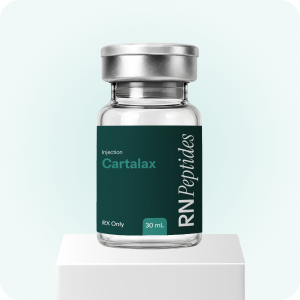
Cartalax
- Injectable format listed in the supplier catalog
- Individual review of your health history and goals
- Clear confirmation of formulation, availability, and full pricing
- Prescription required, with licensed nurse practitioner review
A clinician assesses evidence, risks, eligibility, and availability before any treatment decision. Review all applicable fees and terms before you place an order. The How Ordering Works page walks through each step.
Sources
- Cartalax, Wikipedia overview with reference list
- Myakisheva and colleagues. Peptides of cartilage tissue, regulation of chondrocyte proliferation, geroprotection and prospects for use in osteoarthrosis. Advances in Gerontology, 2023
- Chalisova NI, et al. Peptide regulation of cells renewal processes in kidney tissue cultures from young and old animals. Bulletin of Experimental Biology and Medicine, 2015
- Lin’kova NS, et al. Peptide regulation of skin fibroblast functions during their aging in vitro. Bulletin of Experimental Biology and Medicine, 2016
- Khavinson VK, Lin’kova NS, Tarnovskaya SI. Short peptides regulate gene expression. Bulletin of Experimental Biology and Medicine, 2016
- Ashapkin V, et al. Gene expression in human mesenchymal stem cell aging cultures, modulation by short peptides. Molecular Biology Reports, 2020
- Khavinson V, et al. Tripeptides slow down aging process in renal cell culture. Advances in Gerontology, 2014
- Chalisova NI, et al. Effect of tripeptides on growth of organotypic culture of different genesis tissues, 2022
- Cayman Chemical, H-Ala-Glu-Asp-OH product information
- FDA, Certain Bulk Drug Substances for Use in Compounding That May Present Significant Safety Risks (content current April 22, 2026)
- WADA 2026 Prohibited List, S2 overview (DSHS Cologne)
This article offers education alongside, not in place of, medical advice. Talk with a qualified clinician about your health history before any treatment decision.