

KPV is a tiny peptide with a big reputation. It has three amino acids, a clear lab story, and plenty of online buzz.
You’ll see how KPV works in cells and mice and what FDA found about human data. You’ll also see where the July 2026 advisory vote leaves things. You’ll get direct answers to the questions Google users ask most.
The Quick Answer. KPV is a three-amino-acid peptide made of lysine, proline, and valine. It’s the C-terminal fragment of alpha-MSH, a natural hormone. In cell and mouse studies, KPV lowered inflammatory signaling in the gut and skin. FDA found no studies of KPV in people. An FDA advisory committee voted 8 to 6 in July 2026 to recommend it for compounding. FDA’s final decision is pending.
KPV at a Glance
This snapshot covers the essentials. Each row points to a section below.
| Item | Snapshot |
| Type | Synthetic tripeptide |
| Sequence | Lysine, proline, valine |
| Origin | C-terminal fragment of alpha-MSH |
| Main Research | Cell studies and mouse colitis models |
| Human Studies | None identified by FDA |
| FDA Advisory Vote | 8 to 6 in favor on July 23, 2026 |
| Next FDA Step | Notice-and-comment rulemaking |
What Is KPV?
KPV is a short peptide built from three amino acids. The letters stand for lysine, proline, and valine. FDA describes it as a fragment of alpha-MSH, a neuropeptide the pituitary gland produces.
Researchers became interested because this small piece keeps anti-inflammatory activity. The full alpha-MSH molecule can also act on pigmentation pathways. KPV is a common name, not an official adopted name. Several forms circulate under it, including a free base and an acetate salt.
KPV and Alpha-MSH, the Parent Hormone
Alpha-MSH is a 13-amino-acid hormone, and KPV is its last three. Alpha-MSH acts mainly through melanocortin receptors. KPV didn’t displace alpha-MSH from those receptors in lab tests. That’s why researchers describe KPV as a fragment with its own behavior.
The parent hormone has been studied across many inflammatory models. KPV’s appeal is that it’s much smaller.
How KPV Is Thought to Work
The best-studied explanation comes from a gut study in cells and mice. It follows four steps.
- KPV enters intestinal and immune cells through PepT1, a peptide transporter.
- PepT1 levels rise in inflamed colon tissue.
- Inside the cell, KPV reduces NF-κB and MAP kinase signaling.
- Cells then release fewer inflammatory messengers, such as IL-8.
The study found KPV didn’t raise cAMP, the signal melanocortin receptors use. That points away from the usual alpha-MSH receptors.
What the Gut Studies Show
The key study ran cell experiments and two mouse colitis models. Nanomolar KPV concentrations reduced NF-κB and MAP kinase activation in human intestinal and T cells.
In the DSS model, mice drank water containing KPV for eight days. KPV cut colonic myeloperoxidase activity by about 50 percent there. It cut it by about 30 percent in the TNBS model. It also reduced weight loss and several inflammatory cytokines.
Those are mouse results. They show a signal worth studying in people.
What the Skin Studies Show
Skin research is newer. A 2025 study exposed human keratinocytes to fine particulate matter. KPV at 50 µg/mL restored cell viability and lowered IL-1β secretion. It also eased inflammatory cell death in a three-dimensional skin model.
Those findings come from cultured cells, so they describe the lab setting. FDA’s review also lists rodent studies of wound healing.
What the Antimicrobial and Delivery Studies Add
Two more research threads round out the picture. Some lab work describes activity against Staphylococcus aureus and Candida albicans. That’s one reason KPV appears in wound-care research.
Delivery research asks how to get a peptide to the right tissue. Studies have explored nanoparticles that carry KPV to inflamed intestinal tissue. Formulation shapes what reaches the target, so a peptide’s name alone doesn’t describe a product.
KPV Research by Goal
This table matches each goal to its evidence.
| Goal | Evidence Type | What You Can Say |
| Gut Inflammation | Cell and mouse colitis studies | A promising lab signal |
| Skin Protection | Cultured keratinocytes and a 3D skin model | A promising lab signal |
| Wound Healing | Rodent studies | Early-stage |
| Immune Balance | Cell studies of NF-κB and MAPK signaling | Early-stage |
| Human Outcomes | None identified | Awaiting the first studies |
KPV Research Timeline
This table lines up the key studies and decisions.
| Year | Milestone |
| 1989 | Researchers report anti-inflammatory activity in the alpha-MSH fragment |
| 2003 | A study dissects which parts of alpha-MSH drive the effect |
| 2008 | The PepT1 study shows uptake and mouse colitis results |
| 2017 | A study tests KPV delivery across human cadaver skin |
| 2025 | A study tests KPV in keratinocytes exposed to fine particulate matter |
| 2026 | FDA publishes its briefing, and the committee votes |
How Quickly Does KPV Work?
No human timeline exists, because FDA found no studies of KPV in people. The timelines you read online come from mice and personal stories.
In the DSS model, mice received KPV for eight days. In the TNBS model, researchers measured results at 48 hours. A controlled human study would give the first real answer. A symptom log helps you judge any change in the meantime.
Forms and Routes, Why They Matter
Compounders promote KPV as injectable, oral, topical, and nasal products. The research used different settings. This table shows what to check.
| Form | Research Context | What to Ask |
| Oral | Mouse drinking-water studies | Does the product match the studied route? |
| Topical | Cell models and cadaver-skin studies | What are the concentration and vehicle? |
| Injectable | No human data identified | Who prepared it, and how is sterility tested? |
| Nasal | No human data identified | What evidence covers that exact route? |
In human cadaver skin, KPV crossed the outer layer poorly, and iontophoresis or microneedles improved penetration. Each route needs its own evidence.
How KPV Compares With BPC-157 and TB-500
Online protocols often pair KPV with BPC-157 and TB-500. The advisory committee voted on all three on the same day, with the same 8-to-6 tally.
Their human evidence differs. FDA identified five small clinical studies of BPC-157. It reported no direct human administration studies for TB-500.
How to Read KPV Claims
Strong claims deserve strong questions. Use this list.
- Was it tested in cells, mice, or people?
- Which form and route did the study use?
- Which outcome did researchers measure?
- Does the claim name a disease, such as Crohn’s disease?
- Who sells the product, and who dispensed it?
Animal colitis models aren’t the same as Crohn’s disease or ulcerative colitis in people. Match each claim to the setting where researchers tested it.
What a First Human Study Would Need to Show
Researchers have a clear to-do list. A first human study would measure how the body absorbs and clears KPV. It would track safety and tolerability, and it would test immune reactions. FDA found gaps in each of these areas.
Later trials could compare a defined route and form with a placebo in a specific condition. Those steps would turn a promising lab signal into an answer for patients.
Reading Personal Experiences
Forums and videos fill with KPV stories, including stories about Crohn’s disease. Personal experiences are real, and they can’t prove cause and effect. Many people change several things at once, such as diet, medicines, and stress.
Ask what else changed during the story. Ask which diagnosis and which treatments came before. A clinician can help you compare your situation with what studies tested.
Tracking Symptoms and Labs
Good tracking beats good guesses. KPV has no single direct blood marker. People commonly follow hs-CRP and a metabolic panel alongside their symptoms. Common practice tests at baseline and again at four to six weeks. Your clinician sets your schedule.
- A daily note on digestive comfort and stool changes.
- Skin redness and flare dates.
- Sleep, stress, and diet changes.
- Medicine changes and start dates.
- Labs your clinician orders.
Why Evaluation Comes First
Inflammation is a pattern, not a diagnosis. Gut inflammation can reflect ulcerative colitis, Crohn’s disease, infection, celiac disease, or medication effects. An evaluation finds the cause and opens established options. It can include a history, a medication review, lab work, stool testing, and a specialist referral. Peptide questions fit better after that step.
Choosing a Provider and Pharmacy
Good providers answer these questions clearly.
- Which pharmacy prepares the product?
- Which exact form is it, free base or acetate?
- What licensed clinician oversight is involved?
- How often is follow-up scheduled?
- How are side effects managed?
Verify each clinician’s license with the Texas boards. Verify the pharmacy’s license with the Texas State Board of Pharmacy. Ask for the answers in writing.
Why the Exact Name Matters
A name on a label should match the chemistry behind it. KPV free base and KPV acetate are different active ingredients. In the one nomination FDA reviewed, the certificate of analysis named one form. Its molecular formula matched the other form. A clear order names the form, and a clear label confirms it.
Checking Product Quality and Documentation
Naming and testing matter for peptides. FDA found that most certificates of analysis for KPV list purity only. They lack impurity limits and data on aggregation and microbiological quality. Look for these items.
- The exact form on the label.
- The preparing pharmacy’s name and license.
- A lot number and a beyond-use date.
- Storage instructions for your exact product.
- A certificate of analysis covering identity, impurities, and microbial testing.
Peptides can be sensitive to pH, heat, and storage conditions. Follow your pharmacy label for your exact product.
Questions to Bring to Your Clinician
Walk into the appointment with your questions written down.
- What’s my diagnosis, and what established options fit it?
- What does the evidence show for KPV and my symptoms?
- Which exact form and route are we discussing?
- Which pharmacy prepares it, and how does it document quality?
- Do my medicines or conditions change the plan?
- How will we measure progress?
- When do we reassess or stop?
- What’s the full cost, including labs and follow-up?
A good clinician welcomes these questions.
KPV Safety Information
This section gathers the safety information in one place. Two parts cover what FDA’s review found and what researchers are still learning.
What FDA’s Review Found
FDA found no clinical studies or human exposure data for KPV by any route. It identified no pharmacokinetic, toxicity, genotoxicity, reproductive, or carcinogenicity studies. FDA concluded that KPV’s safety risks in humans are unknown.
FDA’s adverse event database returned no KPV reports through December 3, 2025. Reporting is voluntary, so that result can’t prove safety.
Peptides can provoke immune reactions and can clump into aggregates, even very short ones. No immunogenicity or aggregation data exist for KPV.
Skip use during pregnancy or nursing unless a qualified clinician authorizes it. Anyone with autoimmune disease, inflammatory bowel disease, or chronic infections needs medical review first.
Blood in the stool, severe abdominal pain, or unintended weight loss needs prompt medical care. So do fever, recurrent vomiting, and signs of dehydration.
What Researchers Are Still Learning
FDA says KPV’s molecular targets remain unknown. The PepT1 explanation comes from cell lines and mice. The nomination’s nine references were animal studies and one skin-permeation study, with none in people.
Some wellness sites claim broad benefits, from autoimmune support to joint and post-viral inflammation. No human trial stands behind those claims. FDA also notes that approved therapies exist for wounds, psoriasis, and eczema.
KPV Regulatory Status and Product Safety
This section reflects the sources checked as of October 22, 2026. Three parts cover FDA’s position, the research-use label, and safe use of this guide.
Where FDA Stands
| Topic | Status as of October 22, 2026 |
| FDA-Approved Use | None |
| Part of an Approved Drug | No |
| USP Drug Monograph | None |
| Category 2 List | Removed in April 2026 after nominations were withdrawn |
| FDA Staff Review (May 2026) | Proposed not adding KPV to the 503A bulks list |
| Advisory Vote (July 23, 2026) | Recommended adding it, 8 to 6 with 1 abstention |
| Next Step | Notice-and-comment rulemaking, possibly 2027 or later |
KPV isn’t a component of an FDA-approved drug, and no USP monograph covers it. On April 15, 2026, KPV and 11 other peptides left Category 2. Removal from Category 2 doesn’t automatically confer Category 1 status.
FDA scientists recommended against inclusion. The committee still voted 8 to 6, with one abstention, to recommend KPV. FDA will start notice-and-comment rulemaking, which could happen in 2027 or take years. Until that process finishes, the vote doesn’t itself authorize compounding. State boards of pharmacy can also apply stricter rules.
Ask any provider, including us, for the legal basis, the dispensing pharmacy, and the exact form.
What “Research Use Only” Means
Products sold online “for research use only” aren’t approved or quality-controlled for human use. FDA noted that different forms circulate under the same KPV name. Vendor vials can differ from pharmacy-dispensed products in identity, sterility, and strength. Confirm all three with the dispensing pharmacy.
Treat any supplier that calls KPV “FDA-cleared” or “approved for compounding” as misstating the record.
How to Use This Guide Safely
This guide is education. It doesn’t provide dosing, route, or reconstitution instructions. A prescriber sets any dose after an evaluation. Report suspected side effects through FDA’s MedWatch program. Talk with a qualified clinician about your health history before any treatment decision.
Frequently Asked Questions About KPV
Here are short answers to the most common questions. Each one points back to the detail above.
Who Should Not Take KPV Peptides?
No safe-use group is established, because FDA found no human studies. Anyone who’s pregnant or nursing needs clinician review first. So does anyone with autoimmune disease, inflammatory bowel disease, or chronic infections.
Is KPV the Safest Peptide?
No peptide earns that label by default. FDA says KPV’s safety risks in people are unknown. The safety section lists what FDA found.
How Quickly Does KPV Work?
No human timeline exists. The mouse studies ran eight days and 48 hours. The timeline section explains why.
What Is KPV?
It’s a synthetic tripeptide of lysine, proline, and valine. It’s the C-terminal fragment of alpha-MSH.
Is KPV a Peptide?
Yes. It’s one of the shortest peptides, with just three amino acids.
Does KPV Work Like Alpha-MSH?
Not through the same receptors, according to the gut study. KPV didn’t raise cAMP, and PepT1 uptake appears to matter.
Has KPV Been Studied in Humans?
FDA found no human studies by any route. The research covers cells, mice, rodents, and cadaver skin.
Is KPV FDA Approved?
KPV is investigational. The regulatory section lists FDA’s current position.
Is KPV Legal in 2026?
An advisory committee recommended it for the compounding bulks list in July. FDA’s decision is pending, so ask any provider for the legal basis.
Can KPV Treat Crohn’s Disease or Ulcerative Colitis?
Researchers tested it in mouse colitis models. Nobody has tested it in people with these conditions, so talk with a gastroenterologist.
Can KPV Be Taken by Mouth?
Mouse studies used oral dosing in drinking water. FDA found no human pharmacokinetic data for any route.
How Does KPV Compare With BPC-157?
They’re separate peptides. FDA found five small studies of BPC-157 and none of KPV.
Does KPV Suppress the Immune System?
Sources describe KPV as immune-modulating, not a broad immunosuppressant. Human data are missing, so people with immune conditions need clinician review.
What Is the Difference Between KPV Free Base and Acetate?
FDA treats them as different active ingredients. Labels and orders should name the exact form.
Can I Buy KPV Online?
A clinician and a licensed pharmacy are the safer route. The regulatory section explains research-use products.
Where Can I Learn More?
Start with FDA’s May 2026 briefing document and the 2008 PepT1 study in Gastroenterology.
Talk With RN Peptides About KPV
If you’re exploring gut or skin questions, our team can talk it through. Bring your history, your medicines, and your questions.
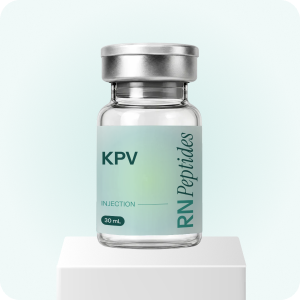
KPV
- Prescription required, with licensed nurse practitioner review
- Formulation and availability confirmed on request
- A product inquiry, with no active checkout
- A personal conversation with a nurse-founded team
Your clinician determines whether a prescription is appropriate. Review all applicable fees and terms before you place an order. The How Ordering Works page walks through each step.
Sources
- FDA, Briefing Document on KPV-Related Bulk Drug Substances, Pharmacy Compounding Advisory Committee (July 23 to 24, 2026)
- Dalmasso G, et al. “PepT1-Mediated Tripeptide KPV Uptake Reduces Intestinal Inflammation.” Gastroenterology, 2008
- Sung et al. KPV and fine particulate matter in human keratinocytes. Tissue & Cell, 2025
- McDermott Will & Schulte, analysis of the July 2026 committee meeting
This article offers education alongside, not in place of, medical advice. Talk with a qualified clinician about your health history before any treatment decision.