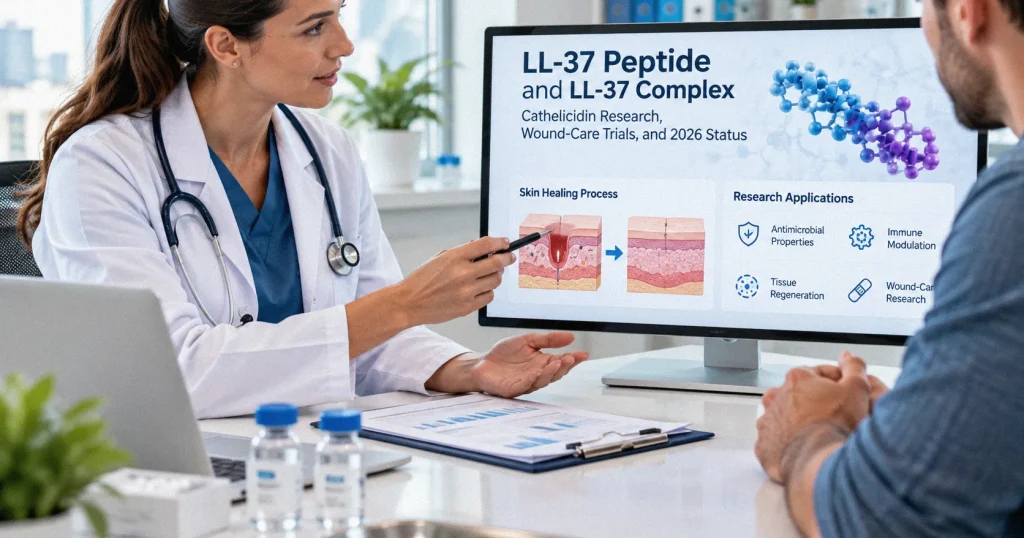

Humans carry exactly one cathelicidin. The cathelicidin family includes about 30 types, and LL-37 is the only one found in humans. That single peptide patrols the skin, the gut, and the airways.
Researchers study LL-37 for three jobs. It defends against microbes, it sends signals between cells, and it helps tissue repair. This guide follows each job and reviews the human trials. It also explains where the LL-37 Complex blend fits. It closes with the 2026 FDA picture.
Three Facts to Anchor On
- LL-37 is a 37-amino-acid fragment of hCAP18, the human cathelicidin precursor.
- The best human data come from topical products used on chronic wounds.
- The RN Peptides listing pairs LL-37 with quercetin and EGCG. Each ingredient carries its own evidence.
The safety and regulatory sections hold the cautions and the legal picture in full.
Meet the Only Human Cathelicidin
The CAMP gene encodes an 18-kDa precursor called hCAP18. That precursor carries a 30-residue signal peptide and a 103-residue cathelin-like domain. A 37-residue peptide sits at the C-terminal end.
The mature peptide, LL-37, begins with two leucines. Its sequence is LLGDFFRKSKEKIGKEFKRIVQRIKDFLRNLVPRTES. At physiological pH it carries a net positive charge of +6.
LL-37 folds into an alpha helix, most strongly near negatively charged lipids. That shape explains much of its behavior at membranes.
How the Body Releases It
Cells store the precursor and cut it when needed. Proteinase 3 releases LL-37 in neutrophils, and kallikrein enzymes release it in skin keratinocytes. Enzymatic processing controls the activity of cathelicidin.
Macrophages and natural killer cells produce LL-37. So do epithelial cells of the skin, airways, eye surface, and intestine. It also appears in neutrophils, testes, and saliva.
What Switches It On
Several signals raise LL-37 production. This table lines up the main ones from laboratory work.
| Signal | Where Researchers Saw the Effect |
| Vitamin D, through its receptor | Neutrophil progenitors, B cells, cervical cells |
| Bacterial infection and LPS | Epithelial cells, macrophages, neutrophils, keratinocytes |
| Short-chain fatty acids | Colon epithelial cells and monocyte-like cells |
| Butyrate from gut bacteria | Colon, gastric, and liver cells |
| Zinc | Intestinal epithelial cells |
| Curcumin | Monocyte-like cells |
Ultraviolet B exposure starts the skin’s vitamin D pathway and can induce LL-37. The peptide is also upregulated in infected and injured skin.
Job One, Defense
LL-37 began its research career as an antimicrobial peptide. Its positive charge draws it toward negatively charged microbial membranes. The helical shape then allows membrane penetration and pore formation.
Cholesterol in mammalian membranes protects host cells from those pores. LL-37 can also inhibit the formation of bacterial biofilms.
Animal studies show the peptide matters in vivo. Mouse studies show the murine version protects the skin, colon, and urinary tract. The murine peptide protected against influenza in mice.
Job Two, Signaling
LL-37 also acts as a messenger. Through formyl peptide receptor 2, it draws neutrophils and eosinophils toward injury. Researchers have linked it to EGFR, ERBB2, P2X7, and GAPDH as well.
It dampens TLR4 signaling by binding bacterial LPS. Researchers describe both pro-inflammatory and anti-inflammatory functions, and the surrounding environment sets the direction. That context-dependence is a central theme of the field.
Job Three, Repair
Wound biology gave LL-37 research its most active clinical thread. LL-37 transactivates the epidermal growth factor receptor, which induces keratinocyte migration and promotes wound healing.
It takes part in cell proliferation, migration, and wound closure. It also induces angiogenesis and regulates apoptosis. Read the 2003 angiogenesis study and the 2005 airway wound-closure study.
The Fragment Family
Researchers cut and redesign LL-37 to learn which parts do what. Fragments of LL-37 keep antimicrobial and anticancer effects and generally show gentler effects on human cells. This table lists the best-known relatives.
| Name | What It Is | What Researchers Reported |
| RK-31, KS-30, KR-20 | Natural fragments | Retain antimicrobial effects |
| ALL-38 | Seminal plasma product | Antimicrobial activity equal to LL-37 |
| FK-16 | Synthetic fragment | Induced apoptosis and autophagy in colon cancer cells |
| FF/CAP18 | Designed analog | Higher antimicrobial and anticancer activity in lab tests |
| SAAP-148 | Modified LL-37 | Killed bacteria more efficiently under physiological conditions |
Read the 2025 review of cathelicidin modifications for a wider survey.
From Dish to Patient, the Human Trials
Four human studies shape the clinical record. This table keeps each one tied to its setting.
| Study | Setting | Route |
| First-in-Human Venous Ulcer Trial, 2014 | Hard-to-heal venous leg ulcers | Topical |
| Phase IIb Venous Ulcer Trial | 148 patients with hard-to-heal ulcers | Topical |
| Diabetic Foot Ulcer Trial, 2023 | Diabetic foot ulcers | Topical cream |
| Melanoma Injection Study | Skin metastases of melanoma | Intratumoral injection |
The 2014 randomized, placebo-controlled study found topical LL-37 safe and well tolerated. It reported a marked effect on healing predictors at the two lower doses.
The phase IIb trial combined compression therapy with twice-weekly topical applications over a 13-week double-blind phase. The safety section covers its overall result.
In the diabetic foot ulcer trial, the granulation index rose more with LL-37. The gap appeared on days 7, 14, 21, and 28. Read the 2023 trial.
A phase I/II study injected LL-37 into melanoma skin metastases. It’s the sole trial found that used injected LL-37.
Reading the Word Complex
The RN Peptides listing carries the name LL-37 Complex. It describes LL-37 combined with quercetin and EGCG. The page states that the blend contains peptide and non-peptide ingredients.
EGCG is the most abundant bioactive polyphenol in green tea. Quercetin and EGCG are both dietary polyphenols. Blends pair ingredients with proposed complementary roles. Each ingredient still brings its own evidence.
The One Study That Paired LL-37 With EGCG
One laboratory study tested the pairing directly. A 2015 report used a three-dimensional model of gingival epithelial cells and fibroblasts. LL-37 and EGCG acted in synergy to reduce several cytokines after an LPS challenge.
The combination kept cell viability and lowered IL-6, IL-8, IP-10, G-CSF, and GRO-alpha. That’s a useful signal from an oral-tissue model. Read the 2015 synergy study.
Five Questions for Any LL-37 Claim
Papers and product pages describe LL-37 in many ways. These questions keep each claim in context.
- Did the study use cells, animals, or people?
- Was the route topical, intratumoral, or injected under the skin?
- Which condition and population did the study enroll?
- Who ran the trial, and who funded it?
- Does the claim describe LL-37 alone or a blend?
A wound trial describes wounds. Other goals call for their own studies.
Everyday Foundations for Your Own Cathelicidin
The body already makes LL-37, and daily habits feed that system. Vitamin D induces LL-37 through the vitamin D receptor. A clinician can check your vitamin D level and advise on sunlight and diet.
Butyrate from gut bacteria and zinc both raised LL-37 in lab cells. A varied diet with plenty of fiber and adequate zinc supports those pathways. Good sleep and regular movement support the immune system overall.
Questions Worth Taking to a Clinician
A good visit starts with your goal. Bring a list.
- What’s my goal, and which established options address it?
- Does the evidence behind LL-37 match my condition and route?
- Which exact formulation are we discussing, and who prepares it?
- How do my skin, immune, and liver history change the plan?
- How will we measure progress, and when do we reassess?
- What’s the full cost, including follow-up?
LL-37 Safety Information
This section gathers the safety information in one place. It covers the trials, FDA’s concerns, immune and cancer biology, brain research, and the blend’s ingredients.
What the Human Trials Reported
In the phase IIb trial, topical LL-37 showed no significant benefit across the full group. A post-hoc analysis found a signal in larger ulcers.
Both venous ulcer trials were run by the company developing the compound. The phase IIb paper lists three authors as sponsor employees. It lists one as a minority shareholder.
A case report from the melanoma injection trial describes skin toxicity. A woman developed verrucous papules and a blistering eruption after repeated LL-37 injections. The lesions resolved within two months of stopping.
No controlled human trials establish efficacy or safety of self-administered LL-37 for wellness uses.
What FDA Says
FDA says compounded LL-37 may pose a risk of immunogenicity by certain routes. It cites complexities with peptide-related impurities and API characterization.
FDA lacks sufficient safety information to know whether LL-37 would cause harm in humans. Nonclinical findings suggest detrimental effects on male reproduction. They also suggest the peptide can be protumorigenic in some tissues.
Immune and Skin Conditions
LL-37 levels are elevated in psoriatic skin. LL-37 and DNA complexes can activate plasmacytoid dendritic cells and raise type I interferon. LL-37 is a common autoantigen in psoriasis. Specific T cells appear in about two thirds of patients with moderate to severe disease.
Patients with rosacea show elevated cathelicidin, and excessive LL-37 is suspected to contribute. Reviews also link LL-37 to lupus, rheumatoid arthritis, and atherosclerosis.
Timing matters. When macrophages receive LPS first, LL-37 then enhances TNF release and inflammasome activation. Read the 2013 review of LL-37 in autoimmune disease.
Cancer Biology
LL-37 is overexpressed in breast, ovarian, and lung cancers. In breast, lung, and prostate cancers, it promotes proliferation, migration, and tumorigenesis through receptor signaling.
In gastric cancer, colon cancer, and T-cell leukemia, it can suppress proliferation. The authors found no conclusive evidence explaining the opposite effects. Read the 2015 cancer review.
Brain Research
A 2022 study found LL-37 promoted membrane translocation and activation of CLIC1 in microglia. In mouse and monkey models, LL-37 produced Alzheimer’s-linked changes, including elevated amyloid-beta and impaired cognition. The authors suggest LL-37 may drive disease progression. Read the 2022 study.
The Blend’s Ingredients
Published case reports associate liver injury with EGCG intake, with wide differences in susceptibility. Green tea related liver injury shows a strong association with the HLA-B*35:01 allele. European regulators identified EGCG as the catechin most tied to liver toxicity.
Those reports describe oral supplements. The sources reviewed include no data on injected EGCG or injected quercetin. They also include no study of LL-37, quercetin, and EGCG together. Read the USP review of green tea extract hepatotoxicity.
Who Needs Extra Caution
Anyone with psoriasis, rosacea, lupus, rheumatoid arthritis, or liver disease needs a clinician first. A cancer history calls for the same step. Men planning to father a child and anyone planning pregnancy should ask first. Skip use during pregnancy, while nursing, or under age 18 unless a qualified specialist authorizes it.
Seek urgent care for a widespread rash, blistering, trouble breathing, or injection-site infection signs. Yellow skin or eyes, dark urine, or severe abdominal pain also need prompt evaluation.
What Researchers Are Still Learning
Researchers still need larger trials, long-term follow-up, and studies of injected products. Peptide drugs break down quickly, which limits routes of administration and raises production cost. Quality-tested products and clear dosing studies would fill the gaps.
LL-37 Regulatory Status and Product Safety
This section reflects the sources checked as of October 28, 2026. It covers FDA status, the advisory committee, the blend, and product quality.
Where LL-37 Stands
| Topic | Status as of October 28, 2026 |
| FDA-Approved LL-37 Product | None |
| 503A Category 2 | Added September 29, 2023, then removed in April 2026 |
| Reason for Removal | The nominator withdrew the nomination |
| 503A Bulks List or Category 1 | Not listed |
| Advisory Committee | Planned before the end of February 2027 |
| Blend Ingredients | Each carries its own status |
A 2026 analysis reports that Drugs@FDA lists no application for LL-37. FDA added cathelicidin LL-37 to 503A Category 2 on September 29, 2023. FDA’s April 2026 update removed it because the nomination was withdrawn.
The removal didn’t place LL-37 in Category 1 or on the 503A bulks list. FDA plans an advisory committee meeting before the end of February 2027 on its potential inclusion. That meeting will also cover four other substances.
Committee recommendations are advisory, and the list changes through rulemaking. See FDA’s categories document and committee meeting page. Ask any provider, including us, for the legal basis, the dispensing pharmacy, and the exact form.
What the Blend Adds
The listing states that the blend contains peptide and non-peptide ingredients. Each ingredient has its own regulatory status, grade, and source. FDA’s August 2026 glutathione alert states that dietary supplement grade ingredients aren’t appropriate for injectable drugs. The same ingredient-grade question applies to every blend component.
Ask which pharmacy prepares the product. Ask what grade and source each ingredient has. Ask for the certificate of analysis for each lot.
Product Quality and Sourcing
Reagent suppliers sell LL-37 for laboratory research. Those products aren’t prepared for human use. Confirm the exact form, the preparing pharmacy, and the testing documents before any treatment decision.
What “Research Use Only” Means
Products sold online “for research use only” aren’t approved or quality-controlled for human use. Vendor vials can differ from pharmacy-dispensed products in identity, sterility, and strength. Confirm all three with the dispensing pharmacy.
RN Peptides lists many investigational compounds for discussion only. A listing doesn’t imply approval for human use, and it doesn’t guarantee availability.
Using This Guide Safely
This guide is education. It doesn’t provide dosing, reconstitution, or injection instructions. A prescriber sets any dose after an evaluation. Report suspected side effects through FDA’s MedWatch program. Talk with a qualified clinician about your health history before any treatment decision.
LL-37 Questions People Ask
What is LL-37?
It’s the only human cathelicidin, a 37-amino-acid peptide the body makes.
What does LL-37 do in the body?
It defends against microbes, signals between cells, and supports wound repair.
Is LL-37 a peptide?
Yes. It’s a 37-amino-acid peptide released from the larger hCAP18 precursor.
What is cathelicidin?
It’s a family of host-defense peptides. LL-37 is the only member in humans.
What is the difference between LL-37 and defensins?
They’re separate families of antimicrobial peptides. Defensins carry six cysteines and form beta-sheet structures.
Does vitamin D raise LL-37?
Vitamin D receptor activation induces the CAMP gene in lab studies.
What is LL-37 Complex?
It’s a listing that pairs LL-37 with quercetin and EGCG. Each ingredient has its own evidence.
What are quercetin and EGCG?
Both are dietary polyphenols. EGCG is the most abundant catechin in green tea.
What do the wound-care trials show?
They tested topical LL-37 in leg and foot ulcers. The trial section and the safety section cover the results.
Has LL-37 been given by injection to people?
One melanoma study used intratumoral injections. The safety section covers its findings.
Is LL-37 FDA approved?
The regulatory section explains its status in detail.
Is LL-37 legal in 2026?
The regulatory section covers the compounding picture. Ask any provider for the legal basis.
Is LL-37 safe?
The safety section lists FDA’s concerns and the research findings.
How is LL-37 dosed?
A prescriber sets the dose after an evaluation. This guide focuses on education.
Where can I read the original research?
The Sources list links the trials, the reviews, and the FDA pages.
Bring Your LL-37 Questions to RN Peptides
If you’re exploring immune, skin, or healing questions, our nurse practitioners can talk it through. Bring your history, your medicines, and what you’ve read. Ask which pharmacy prepares a product and how it verifies each ingredient.
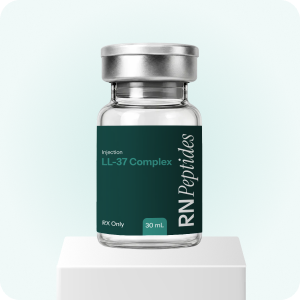
LL-37 Complex
- Injectable format listed in the supplier catalog
- Individual review of your health history and goals
- Clear confirmation of formulation, availability, and full pricing
- Prescription required, with licensed nurse practitioner review
A clinician assesses evidence, risks, eligibility, and availability before any treatment decision. Review all applicable fees and terms before you place an order. The How Ordering Works page walks through each step.
Sources
- Kuroda K, et al. The human cathelicidin antimicrobial peptide LL-37 and mimics are potential anticancer drugs. Frontiers in Oncology, 2015
- Kahlenberg JM, Kaplan MJ. Little peptide, big effects, the role of LL-37 in inflammation and autoimmune disease. Journal of Immunology, 2013
- Voronko OE, et al. Antimicrobial peptides of the cathelicidin family, focus on LL-37 and its modifications. International Journal of Molecular Sciences, 2025
- Koczulla R, et al. An angiogenic role for the human peptide antibiotic LL-37/hCAP-18. Journal of Clinical Investigation, 2003
- Shaykhiev R, et al. Human endogenous antibiotic LL-37 stimulates airway epithelial cell proliferation and wound closure. American Journal of Physiology, 2005
- Grönberg A, et al. Treatment with LL-37 is safe and effective in enhancing healing of hard-to-heal venous leg ulcers. Wound Repair and Regeneration, 2014
- Efficacy of LL-37 cream in enhancing healing of diabetic foot ulcer, a randomized double-blind controlled trial (2023)
- Lombardo Bedran TB, et al. Green tea polyphenol EGCG and cranberry proanthocyanidins act in synergy with cathelicidin (LL-37) to reduce the LPS-induced inflammatory response. Archives of Oral Biology, 2015
- Chen X, et al. Human antimicrobial peptide LL-37 contributes to Alzheimer’s disease progression. Molecular Psychiatry, 2022
- Vuppalanchi R, et al. United States Pharmacopeia comprehensive review of the hepatotoxicity of green tea extracts. Toxicology Reports, 2020
- FDA, Certain Bulk Drug Substances for Use in Compounding That May Present Significant Safety Risks
- FDA, Bulk Drug Substances Nominated for Use in Compounding Under Section 503A (categories document)
- FDA, Pharmacy Compounding Advisory Committee meeting page
- FDA, FDA reminds compounders not to use dietary supplement grade glutathione for injectables (August 27, 2026)
This article offers education alongside, not in place of, medical advice. Talk with a qualified clinician about your health history before any treatment decision.