

Hard training does more than tire a muscle. It starts a chain of local signals that organize repair. Researchers gave one of those signals a memorable name, mechano growth factor, or MGF.
MGF sits at the meeting point of exercise science, aging research, and the peptide market. This guide separates the molecule from the marketing. It covers the biology, the cell and biopsy studies, and the difference between MGF and PEG-MGF. It closes with the 2026 FDA and anti-doping picture.
Terms You’ll See
- MGF. A splice variant of the IGF-1 gene, made in muscle after mechanical loading.
- IGF-1Ec and IGF-1Eb. The human and rodent names for the MGF transcript.
- MGF E peptide. The short peptide piece that lab studies test directly.
- PEG-MGF. A pegylated form of MGF sold under its own name.
The safety and regulatory sections hold the cautions and the legal picture in full.
One Gene, Several Messages
Cells can read one gene in more than one way. The IGF-1 gene is a good example. MGF, also called IGF-1Ec, has a unique E domain with a 49-base-pair insert in humans. That insert shifts the reading frame and produces a distinct mature isoform.
The 24-amino-acid C-terminal peptide separates from the 70-amino-acid mature IGF-1 protein. Researchers call that peptide MGF. Mature IGF-1 and the E peptide are therefore different pieces of one precursor.
Why It Carries the Word Mechano
The name records the discovery. Researchers named it mechano growth factor because muscle expresses it after mechanical stimulation. It also carries a different carboxy peptide sequence from the liver type of IGF-1. Muscle IGF-1 isoforms come from one gene, yet researchers found they need separate characterization.
After rodent muscle injury, the IGF-1Eb variant rises first. IGF-1Ea follows at later time points. The early variant tracks with satellite cell and myoblast proliferation. The later variant tracks with differentiation into mature fibers.
Why Age Matters to Researchers
Loss of muscle mass and strength is a major problem during aging. MGF expression depends on both exercise and age. That pairing explains why so many studies compare young and older donors.
The 2011 team used muscle cells from neonatal, young adult, and old adult donors. The design lets researchers ask whether age changes the response.
A Repair Sequence in Five Steps
Researchers describe a tidy model. It remains a model, and parts of it are still under study.
- Mechanical loading or damage reaches the muscle fiber.
- The IGF-1 gene is spliced toward the MGF form.
- MGF levels rise early, then decline within a few days in rodent injury studies.
- Satellite cells activate and begin to divide.
- Later IGF-1 forms support maturation into working muscle fibers.
In rodent work, MGF appeared rapidly after local damage and then declined within a few days. That brief window explains why timing matters in every study.
Satellite Cells, the Repair Crew
Satellite cells are muscle stem cells. They sit beside fibers and wake up after injury. They divide, then fuse with damaged fibers to rebuild them.
Researchers study MGF E peptide for its effects on satellite cell activation, proliferation, and fusion. Those three steps are the core of muscle repair. They also explain the interest in MGF for aging muscle.
What Human Muscle Does After Training
Human biopsy studies measure the body’s own MGF signal. A 2003 study sampled thigh muscle from two groups of men. The young men were 25 to 36, and the older men were 70 to 82. A single bout of high-resistance exercise raised MGF mRNA in the young men.
The authors saw the older men’s response as a marker of age-related sensitivity to loading. That finding opened the question of whether older muscle can respond with training.
A later study enrolled healthy elderly men. Five weeks of resistance training raised MGF mRNA by 163 percent. It also raised IGF-1Ea mRNA by 68 percent and IGF-1Eb mRNA by 75 percent.
The Laboratory Record
Cell studies test MGF E peptide directly. This table lines up the main reports and reviews.
| Study | System | What Researchers Reported |
| Kandalla, 2011 | Primary human muscle cells from three age groups | More proliferative life span and delayed senescence in cells from neonatal and young adult donors |
| Ates, 2007 | ALS, dystrophic, and normal muscle | MGF increased progenitor cells |
| Philippou, 2009 | Human muscle after exercise damage | Measured IGF-1 isoform expression and characterized MGF E peptide actions in vitro |
| Liu, 2023 | Chondrocytes and cartilage defects | A concise review of MGF in cartilage |
| Peng, 2012 | Osteoblasts under mechanical stimulation | Studied the nuclear localization of the MGF receptor |
In the Kandalla study, the peptide also produced hypertrophy with fewer reserve cells in all cultures. The authors concluded it markedly enhances satellite cell activation, proliferation, and fusion.
Beyond Muscle, Cartilage and Bone
Mechanical loading reaches other tissues too. A 2023 review examined MGF in chondrocytes and cartilage defects. A 2012 study followed the MGF receptor into the nucleus of osteoblasts under mechanical stimulation.
Those reports show why the idea of a loading signal attracts attention beyond muscle. They also show how early the work is. Each tissue brings its own questions.
What PEG-MGF Is
PEG-MGF is a modified form of MGF. It’s a pegylated version, chemically altered for a longer half-life. The modification adds a polyethylene glycol moiety to extend how long the peptide lasts.
A modified molecule is a different molecule. Findings for native MGF apply to that molecule, and PEG-MGF needs its own data. Each form needs its own identity, stability, and safety information.
Three Molecules Side by Side
This table keeps the terms apart.
| Molecule | What It Is | Where It Comes From |
| Mature IGF-1 | 70-amino-acid growth factor | The main IGF-1 protein |
| MGF E Peptide | 24-amino-acid C-terminal peptide | The unprocessed IGF-1Ec precursor |
| PEG-MGF | Pegylated form of MGF | A chemically modified product |
Ask for the exact molecule name behind any study or product.
How to Read MGF Claims
Claims about muscle need matching evidence. This table shows what would support each common one.
| Claim | What Would Support It |
| Builds muscle | Controlled human trials measuring lean mass and strength |
| Speeds recovery | Trials in a defined injury with a placebo group |
| Works at any age | Results reported separately for each age group |
| A longer-lasting form works better | Pharmacokinetic and clinical data for that exact form |
| Matches what training does | A direct comparison with a training-only group |
Cell results show what a peptide can do in a dish. Human trials show what it does in people.
Training Builds Your Own Signal
The body already makes MGF, and training is a well-documented way to raise it. Progressive resistance work raised MGF mRNA even in older men. Consistent loading, enough protein, and good sleep support the repair process.
Researchers describe resistance exercise as a kick start for hypertrophy and local repair. A coach or physical therapist can tailor a plan to your injury history. Those habits shape results with any plan you choose.
Questions Worth Taking to a Sports Medicine Clinician
A good visit starts with your goal. Bring a list.
- What’s my diagnosis, and which established treatments fit it?
- Which rehabilitation plan fits my injury and my schedule?
- Does the MGF research apply to my situation?
- Which exact molecule are we discussing, MGF or PEG-MGF?
- How do my medicines and conditions change the plan?
- How will we measure progress, and when do we reassess?
MGF Safety Information
This section gathers the safety information in one place. It covers FDA’s findings, the research disagreements, growth-signal questions, and the precautions.
What FDA Says About PEG-MGF
FDA says compounded PEG-MGF may pose significant risk for immunogenicity by certain routes. It also cites complexities with peptide-related impurities and API characterization.
FDA has not identified any human exposure data on PEG-MGF by any route. FDA lacks important information about whether it would cause harm in humans.
What the Human Record Shows
There are no controlled human trials of MGF or PEG-MGF for muscle or recovery. The strongest human evidence is observational, and it measured the body’s own MGF.
Cell studies show effects in culture, and the marketed benefit remains unproven in people.
Where the Research Disagrees
One review found no differences in IGF-1Ec mRNA between young and old men in human muscle. It also called the evidence for a rise after resistance exercise in young men conflicting.
A 2014 study reported no apparent peptide effect on myoblasts or primary stem cells. Read the 2014 replication study and the 2010 review.
In the human cell study, the peptide’s lifespan effect didn’t appear in cells from old donors.
Growth-Signal Questions
One study reported preferential MGF transcript expression in human prostate cancer tissue. It also described autonomous growth factor activity of the MGF E peptide in prostate cancer cells.
Public status summaries note concerns about abnormal growth signals, hypoglycemia-like effects, and unknown long-term risk. The 2011 authors hypothesize that MGF E peptide avoids the oncogenic effects seen with IGF-1. That remains a hypothesis.
Who Needs Extra Caution
Anyone with a cancer history or a growth-sensitive condition needs a clinician first. People with diabetes or low blood sugar episodes need the same step. Skip use during pregnancy, while nursing, or under age 18 unless a qualified specialist authorizes it.
Seek urgent care for fainting, severe weakness, confusion, or signs of infection at an injection site. Hives, facial swelling, or trouble breathing need emergency care.
What Researchers Are Still Learning
Researchers still need controlled human trials, pharmacokinetic data for the pegylated form, and long-term follow-up. They also need agreement on whether MGF acts as a distinct peptide in living muscle. Quality-tested products would make those studies possible.
MGF Regulatory Status and Product Safety
This section reflects the sources checked as of October 28, 2026. It covers FDA status, the committee review, anti-doping rules, and product quality.
Where MGF and PEG-MGF Stand
| Topic | Status as of October 28, 2026 |
| FDA-Approved Product | None |
| PEG-MGF in Category 2 | Removed effective April 22, 2026, after the nomination was withdrawn |
| 503A Eligibility | Removal alone doesn’t make it eligible |
| Advisory Committee | Planned before the end of February 2027 |
| Native MGF | Reported in Category 3, nominated without adequate support |
| WADA 2026 List | Prohibited at all times |
FDA removed 12 peptides, including PEG-MGF, from 503A Category 2 effective April 22, 2026. Removal doesn’t make them legal for compounding automatically. Each still needs an advisory committee recommendation and a final FDA rule.
FDA plans separate advisory committee consultation on PEG-MGF before the end of February 2027. One analysis reports that FDA lists native MGF in Category 3. That category covers substances nominated without adequate support. See FDA’s advisory committee page. Ask any provider, including us, for the legal basis, the dispensing pharmacy, and the exact form.
Anti-Doping Status
WADA’s 2026 S2 class lists mechano growth factors by name. S2 substances are prohibited at all times, in and out of competition. Athletes subject to testing can face sanctions.
Product Quality and Sourcing
The pegylated form sold on the market is uncharacterized as a pharmaceutical. Confirm the form, the preparing pharmacy, and the testing documents before any treatment decision.
What “Research Use Only” Means
Products sold online “for research use only” aren’t approved or quality-controlled for human use. Vendor vials can differ from pharmacy-dispensed products in identity, sterility, and strength. Confirm all three with the dispensing pharmacy.
RN Peptides lists many investigational compounds for discussion only. A listing doesn’t imply approval for human use, and it doesn’t guarantee availability.
Using This Guide Safely
This guide is education. It doesn’t provide dosing, reconstitution, or injection instructions. A prescriber sets any dose after an evaluation. Report suspected side effects through FDA’s MedWatch program. Talk with a qualified clinician about your health history before any treatment decision.
MGF Questions People Ask
What is MGF peptide used for?
Researchers study it for muscle repair, satellite cell activity, and aging muscle. The research sections show the evidence for each.
When should you avoid MGF peptide?
Several groups need a clinician first. The safety section lists them.
Does MGF build muscle?
Cell and animal studies examine that idea. Human data so far measure the body’s own MGF in biopsies.
What is mechano growth factor?
It’s a splice variant of the IGF-1 gene that muscle makes after mechanical loading.
What is the difference between MGF and IGF-1?
They come from one gene. MGF carries a distinct E domain, and mature IGF-1 has 70 amino acids.
What is IGF-1Ec?
It’s the human name for the MGF transcript. Rodents use IGF-1Eb.
What is PEG-MGF?
It’s a pegylated form of MGF, modified for a longer half-life.
What is a splice variant?
It’s a version of a gene’s message cut and joined in a different way. MGF is one such version.
What does pegylated mean?
It means polyethylene glycol was attached to the molecule. The goal is a longer half-life.
Why do studies use young and old donors?
Age may change how muscle cells respond. Comparing groups shows whether a result holds across ages.
What are satellite cells?
They’re muscle stem cells that activate after injury and help rebuild fibers.
Does age change the MGF response?
A 2003 biopsy study compared young and older men. A later study found resistance training raised MGF mRNA in elderly men.
Does exercise raise natural MGF?
Resistance exercise raised MGF mRNA in the human studies cited here. Results vary between studies.
Is MGF FDA approved?
The regulatory section explains its status in detail.
Is MGF legal in 2026?
The regulatory section covers the committee review. Ask any provider for the legal basis.
Is MGF banned in sports?
Yes. WADA’s S2 class lists mechano growth factors.
How is MGF dosed?
A prescriber sets the dose after an evaluation. This guide focuses on education.
Where can I read the original studies?
The Sources list links the cell studies, the biopsy research, and the FDA pages.
Bring Your MGF Questions to RN Peptides
If you’re exploring recovery or muscle questions, our nurse practitioners can talk it through. Bring your history, your injury details, and what you’ve read. Ask which form a product contains and how its identity is documented.
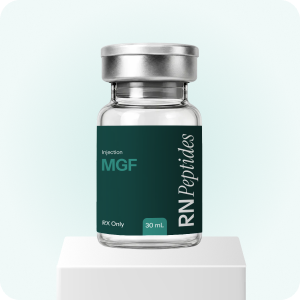
MGF
- Injectable format listed in the supplier catalog
- Individual review of your health history and goals
- Clear confirmation of formulation, availability, and full pricing
- Prescription required, with licensed nurse practitioner review
A clinician assesses evidence, risks, eligibility, and availability before any treatment decision. Review all applicable fees and terms before you place an order. The How Ordering Works page walks through each step.
Sources
- Kandalla PK, et al. Mechano growth factor E peptide (MGF-E), derived from an isoform of IGF-1, activates human muscle progenitor cells and induces an increase in their fusion potential at different ages. Mechanisms of Ageing and Development, 2011
- Matheny RW Jr, Nindl BC, Adamo ML. Mechano-growth factor, a putative product of IGF-I gene expression involved in tissue repair and regeneration. Endocrinology, 2010
- Goldspink G. Mechanical signals, IGF-I gene splicing, and muscle adaptation. Physiology, 2005
- Hameed M, et al. The effect of recombinant human growth hormone and resistance training on IGF-I mRNA expression in the muscles of elderly men. Journal of Physiology, 2004
- Hameed M, et al. Expression of IGF-I splice variants in young and old human skeletal muscle after high resistance exercise. Journal of Physiology, 2003
- Fornaro M, et al. Mechano-growth factor peptide, the COOH terminus of unprocessed insulin-like growth factor 1, has no apparent effect on myoblasts or primary muscle stem cells. American Journal of Physiology, Endocrinology and Metabolism, 2014
- Ates K, et al. The IGF-I splice variant MGF increases progenitor cells in ALS, dystrophic, and normal muscle. FEBS Letters, 2007
- Philippou A, et al. Expression of IGF-1 isoforms after exercise-induced muscle damage in humans, characterization of the MGF E peptide actions in vitro. In Vivo, 2009
- Velloso CP, Harridge SD. Insulin-like growth factor-I E peptides, implications for aging skeletal muscle. Scandinavian Journal of Medicine and Science in Sports, 2010
- Liu Y, et al. The role of mechano growth factor in chondrocytes and cartilage defects, a concise review. Acta Biochimica et Biophysica Sinica, 2023
- Peng Q, et al. The nuclear localization of MGF receptor in osteoblasts under mechanical stimulation. Molecular and Cellular Biochemistry, 2012
- Armakolas A, et al. Preferential expression of IGF-1Ec (MGF) transcript in cancerous tissues of human prostate, evidence for a novel and autonomous growth factor activity of MGF E peptide in human prostate cancer cells
- FDA, Certain Bulk Drug Substances for Use in Compounding That May Present Significant Safety Risks (content current April 22, 2026)
- FDA, Pharmacy Compounding Advisory Committee meeting page
- WADA 2026 Prohibited List, S2 overview (DSHS Cologne)
This article offers education alongside, not in place of, medical advice. Talk with a qualified clinician about your health history before any treatment decision.